|
TRANSLATE THIS ARTICLE
Integral World: Exploring Theories of Everything
An independent forum for a critical discussion of the integral philosophy of Ken Wilber
  Frank Visser, graduated as a psychologist of culture and religion, founded IntegralWorld in 1997. He worked as production manager for various publishing houses and as service manager for various internet companies and lives in Amsterdam. Books: Ken Wilber: Thought as Passion (SUNY, 2003), and The Corona Conspiracy: Combatting Disinformation about the Coronavirus (Kindle, 2020). Frank Visser, graduated as a psychologist of culture and religion, founded IntegralWorld in 1997. He worked as production manager for various publishing houses and as service manager for various internet companies and lives in Amsterdam. Books: Ken Wilber: Thought as Passion (SUNY, 2003), and The Corona Conspiracy: Combatting Disinformation about the Coronavirus (Kindle, 2020).
Check out my other conversations with ChatGPT The Scaffolding Isn't the BuildingA Reply to 'The Ground That Individuates Itself'Frank Visser / Claude
IntroductionJohn Abramson's latest contribution "The Ground That Individuates Itself" is his most sophisticated yet—and precisely because of that sophistication, its central maneuver deserves to be examined with particular care. The essay performs a kind of escalating commitment: each round, the Cantor apparatus is granted more and more explanatory weight, until in this piece it has been upgraded from "analogy" to "genuine explanatory machinery" to "candidate explanatory theory." That trajectory is the problem, not the solution. Elaborating a formal structure with growing confidence does not close the gap between the structure and the phenomena it is supposed to explain. It widens that gap, because it raises the stakes of the question that Abramson has still not answered: why this correspondence? Before we can evaluate the argument, however, readers unfamiliar with the mathematical machinery deserve a plain account of what the aleph numbers actually are—because Abramson deploys them with considerable technical confidence while never stopping to explain them. What the Aleph Numbers Actually AreGeorg Cantor, the nineteenth-century mathematician who founded modern set theory, made the startling discovery that not all infinities are the same size. Some infinite collections are genuinely larger than others—not just subjectively, but in a rigorous, provable sense. The smallest infinity is called ℵ0 (aleph-null). It is the cardinality—the "size"—of the counting numbers: 1, 2, 3, 4, and so on forever. Any collection whose members can be placed in a one-to-one correspondence with the counting numbers shares this cardinality. The integers, the rational numbers (all fractions), and even the set of all finite strings of symbols are all ℵ0 in size, which is counterintuitive but mathematically precise. The key structural feature of ℵ0 is discreteness: the natural numbers are individually enumerable, each cleanly separated from its neighbours, with no element between 1 and 2. ℵ1 is the next infinite cardinal. Cantor proved—in one of the most celebrated results in mathematics—that the real numbers (all points on a continuous number line, including irrationals like p and v2) cannot be placed in correspondence with the counting numbers. There are, in a precise sense, more of them. The cardinality of the real numbers is called the cardinality of the continuum. Whether this equals ℵ1 exactly is actually undecidable within standard set theory—this is the famous Continuum Hypothesis—but Abramson treats them as equivalent, which is a common simplification. The key structural feature here is continuity: between any two real numbers, no matter how close, there are infinitely many others. There are no gaps, no discrete steps. ℵ2, ℵ3, ℵ4, and so on are successively larger infinite cardinals, each unreachable from the previous by any process of accumulation within that level. Cantor showed you can always generate a larger infinity by taking the power set—the set of all subsets—of any given set. This generates an endless tower of infinities, each dwarfing those below. The Absolute Infinite is Cantor's name for the totality of all cardinals—the "infinity of infinities." Crucially, it cannot itself be a well-defined set within the hierarchy, because treating it as one generates logical paradoxes (Russell's paradox being the most famous). In modern set theory, such totalities are called proper classes and are treated as playing a categorically different structural role from sets within the hierarchy. Abramson's Mapping: Mind Levels to AlephsAbramson proposes a direct correspondence between these mathematical structures and the hierarchy of consciousness described across contemplative traditions: ℵ0 → The Gross Realm (ordinary waking experience). Because ℵ0 is discrete and enumerable, Abramson argues it maps onto the sharp-edged, bounded, digital character of everyday material experience: distinct objects, a bounded self, the all-or-nothing firing of neurons. ℵ1 → The Subtle Realm (meditative and dream states, expanded awareness). Because ℵ1 is continuous—no gaps, infinite density—it maps onto the flowing, boundary-dissolving, interpenetrating character that contemplative traditions attribute to subtle-state experience. ℵ2, ℵ3, ℵ4... → The Causal Realm (deep formless absorption, the jhanas of Buddhist practice, degrees of witness consciousness). These higher, increasingly remote infinities are said to correspond to states of awareness that are progressively more undifferentiated yet retain some degree of structure. The Absolute Infinite → The Nondual (the groundless ground of awareness itself, as described in Advaita Vedanta, Zen, and Madhyamaka). Because the Absolute cannot be a member of the hierarchy it grounds—because any attempt to grasp it as an object within the domain it makes possible generates contradiction—Abramson argues it maps precisely onto what the traditions mean when they say the nondual cannot be made an object of experience or conceptual grasp. A diagram may help orient readers to the overall structure: 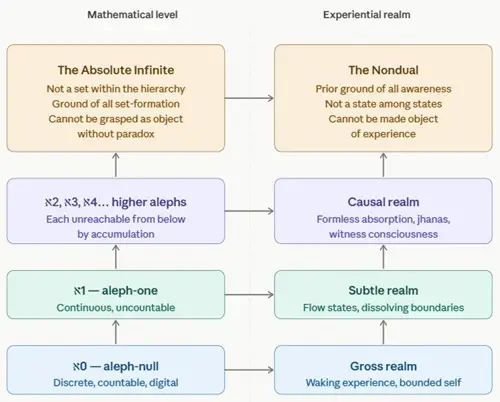 This mapping is the core of Abramson's proposal. With it in hand, we can evaluate what he claims it accomplishes—and why those claims fail. The Central Problem: Correspondence Is Not ExplanationLet us take the central proposal seriously. The gross realm corresponds to ℵ0 because, Abramson says, ℵ0 is discrete and countable, and gross experience has discrete, bounded character—sharp object edges, distinct self/other boundaries, digital neural signaling. The subtle realm corresponds to ℵ1 because ℵ1 is the cardinality of the continuum, and subtle-state experience reportedly has a flowing, continuous, boundary-dissolving character. This is elegant. But elegance is not explanation. The correspondences Abramson identifies are based on phenomenological descriptions—and those descriptions are themselves already metaphors. "Flowing," "continuous," "dissolving," "sharp-edged" are experiential qualities borrowed from physical and spatial vocabulary to describe states that, by the traditions' own insistence, exceed ordinary conceptual categories. The question is whether these borrowed descriptors map onto the mathematical properties of the alephs in any way that is not itself a further metaphor. The answer, on inspection, is that they do not. "Continuous" as a description of subtle-state experience in, say, Tibetan dream yoga or Theravada jhana reports means something like "phenomenologically unbroken" or "without felt gaps." "Continuous" in Cantor means a specific topological and set-theoretic property: uncountability, the intermediate value theorem, the cardinality of the power set of the naturals. These are not the same concept. The fact that the same English word is used for both does not establish a structural correspondence; it establishes a lexical coincidence. This is not a minor technical complaint. The entire weight of the programme Abramson is proposing rests on the claim that the structural properties of each aleph level genuinely correspond to the phenomenological character of each realm. But what would it mean for this correspondence to be genuine rather than analogical? For it to be genuine, there would need to be some principled account of why awareness operating at a particular level of cardinality would exhibit the experiential character associated with that cardinality. Abramson provides no such account. He asserts the correspondences, details them with increasing specificity, and concludes that the specificity of the detailing is itself evidence of explanatory depth. But a detailed map of two domains that happen to share some structural vocabulary is not an explanation of why they are connected. It is still an analogy, however elaborated. A Genuine Explanation Would Look DifferentCompare this to a case where a mathematical structure genuinely explains a physical phenomenon. General relativity's explanation of gravitational lensing works because we have an account—a derivation—showing that if spacetime has the metric structure Einstein's equations specify, then light must follow geodesics that curve near massive objects. The mathematics connects to the phenomenon through a chain of principled inference, not through noting that "curved spacetime" and "bent light" both involve the concept of curvature. Abramson's framework offers no analogous derivation. Why should awareness operating at the ℵ0 level of the cardinality hierarchy produce any experience at all, let alone one with discrete, bounded character? The framework presupposes that awareness is already present at each level and then characterizes how it presents—it does not explain how the structural properties of the cardinality level produce the phenomenal qualities associated with it. In other words, the framework inherits rather than solves the hard problem. It relocates the explanatory gap from "why does this physical organisation produce experience?" to "why does awareness operating at this aleph level produce this kind of experience?" But the second question is no more tractable than the first, for exactly the same reason: we have no account of why any structural-mathematical property should be accompanied by any phenomenal quality. The Cerebellum Argument Runs BackwardsConsider the cerebellar argument, which Abramson deploys as a "neurological instance of a mathematical theorem." His claim is that the cerebellum's failure to generate experiential richness commensurate with its neuron count illustrates the principle that no accumulation of ℵ0 elements can produce ℵ1 cardinality. But this argument runs in precisely the wrong direction for his purposes. Abramson wants to show that consciousness cannot be explained by adding up neurological elements—that quantity of neurons is insufficient. Fine. But the mathematical theorem he cites says that you cannot get from ℵ0 to ℵ1 by counting up more elements of the same type. The actual neuroscientific explanation of the cerebellum's limited role in consciousness has nothing to do with cardinality—it concerns the organisational topology of cerebellar circuits, which are primarily feed-forward rather than recurrently integrated, and which therefore do not generate the kinds of dynamic, self-sustaining activity patterns associated with conscious processing. That is an explanation within the generation framework, and it is detailed, predictive, and mechanistically grounded. Abramson's aleph gloss adds no explanatory content whatsoever; it is a post-hoc mathematical redescription of an observation that was already explained on purely neurological grounds. The Decomposition Problem and Its Concealed TensionThe treatment of the decomposition problem is the philosophical centrepiece of the essay. Abramson's move here is genuinely interesting: he rejects standard cosmopsychism's "cosmic subject that fragments" model and proposes instead a "relational nondual"—a ground that is intrinsically one-and-many, whose relational structure already implies the structural diversity that grounds individuation. This avoids the most obvious version of the decomposition problem. But it does so at a price that is not disclosed. If the nondual is already one-and-many, already structurally differentiated in a way that grounds individual perspectives, then it is not the "prior ground of all determination" that Abramson also needs it to be. It is itself already determinate—already structured as relational, already implying relata. This is a live tension in the Madhyamaka-influenced picture Abramson is drawing on: radical interdependence (pratityasamutpada) says phenomena arise together in mutual dependence, which is different from saying that a prior unified ground differentiates itself into perspectives. Abramson needs the nondual to be both the undivided prior ground (to do the work of the Absolute Infinite) and the already-relational one-and-many (to avoid the decomposition problem). These are distinct and potentially incompatible roles, and the essay does not address the tension between them. There is also a more fundamental issue with the decomposition-problem response. Abramson says individuation is explained by the structural properties of the gross realm's ℵ0 character—awareness operating under conditions of discrete, digital organisation is individuated into bounded perspectives as a natural result of those conditions. But this account, if taken seriously, makes individuation a product of the gross material substrate—which is precisely what the generation model would say. Abramson's language throughout—consciousness "operating within" ℵ0 conditions, awareness "expressed through" a specific organism—is systematically ambiguous between transmission (the glass shapes the light that already exists) and generation (the glass produces the light). The hard problem's force comes precisely from the fact that this ambiguity cannot be resolved by metaphor, however mathematically decorated. On "Symmetric Scepticism"On the accusation that suspending judgment is a political rather than philosophical stance: Abramson's argument here has some genuine force, and it is worth acknowledging that the default position in any institutional context does carry advantages that are not purely epistemic. But the response conflates two things. The first is the reasonable point that institutional dominance is not evidence of truth. The second is the much stronger claim that suspending judgment while seeking better conceptual tools is dishonest and amounts to covert endorsement of the dominant framework. The second claim is simply wrong. Acknowledging that neither the generation nor the transmission model has solved the hard problem is not the same as accepting the generation model's authority. It is possible—and philosophically sober—to conclude that both frameworks face deep unresolved problems and that neither has yet demonstrated the explanatory resources needed to close those problems. This is not suspension of judgment as a hiding place; it is suspension of judgment as an accurate description of the situation. Conclusion: The Sketch Is Not the HandholdWhat Abramson's essay ultimately illustrates is a recurring pattern in consciousness studies: a genuine insight—that the hard problem is real, that the transmission model deserves serious consideration, that contemplative phenomenology is an underutilised data source—is wrapped in a formal apparatus that lends it an air of precision and rigour without delivering the actual explanatory content that precision and rigour would require. The structural specificity of the framework increases with each round of debate, but the fundamental question—why should any mathematical structure be accompanied by any phenomenal character?—remains as unanswered in this essay as it was in the first. Mathematical sophistication is not a substitute for a theory of why mathematics and mind meet. The instrument Koch's phone could not find on Amazon is not the aleph hierarchy. The aleph hierarchy is, at this point in the argument, an elaborate sketch of where such an instrument might eventually hang—drawn on the cliff face in formal notation, looking precise, but not yet a handhold.
Comment Form is loading comments...
|