|
TRANSLATE THIS ARTICLE
Integral World: Exploring Theories of Everything
An independent forum for a critical discussion of the integral philosophy of Ken Wilber
  Frank Visser, graduated as a psychologist of culture and religion, founded IntegralWorld in 1997. He worked as production manager for various publishing houses and as service manager for various internet companies and lives in Amsterdam. Books: Ken Wilber: Thought as Passion (SUNY, 2003), and The Corona Conspiracy: Combatting Disinformation about the Coronavirus (Kindle, 2020). Frank Visser, graduated as a psychologist of culture and religion, founded IntegralWorld in 1997. He worked as production manager for various publishing houses and as service manager for various internet companies and lives in Amsterdam. Books: Ken Wilber: Thought as Passion (SUNY, 2003), and The Corona Conspiracy: Combatting Disinformation about the Coronavirus (Kindle, 2020).
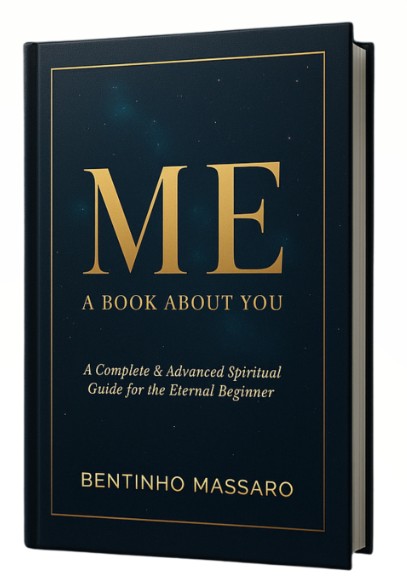
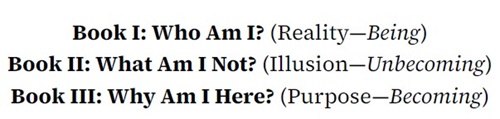
Check out my other conversations with ChatGPT ‘ME: A Book About You (Book I)’ by Bentinho MassaroA Critical ReviewFrank Visser / ClaudeWhat the Book IsME: A Book About You is an ambitious, sprawling 1,236-page spiritual manual structured around non-dual philosophy—the tradition that holds that the individual self is ultimately identical with an infinite, impersonal awareness (Brahman, God, Source, the Absolute). Massaro draws heavily on Advaita Vedanta, particularly the teachings of Ramana Maharshi and Nisargadatta Maharaj, blending these with elements from Christian mysticism, Buddhism, and a distinctly modern self-help tone. Book I addresses the question "Who Am I?" and is divided into theoretical and practical sections, closing with 55 meditation "keys" and practical implementation tips. What WorksThe core philosophical tradition is sound. The non-dual inquiry tradition Massaro draws from—"Who is the witness of experience?"—is genuinely ancient, well-tested, and has produced some of the most rigorous contemplative literature in existence. When Massaro straightforwardly conveys this material (the "neti neti" practice, the distinction between awareness and objects, the inquiry into the sense of "I AM"), the instructions are workable and intelligible. He is clearly not inventing these insights; he is transmitting a real lineage. The structure and systematic approach have genuine merit. The five-level model of understanding (literal → intellectual → experiential → ontological → absolute) is a useful pedagogical framework. The chapter-coding system, however excessive for a single book, shows care for the learner's orientation. The practical section with meditation keys is more useful than much of the theoretical scaffolding. Some passages are genuinely clear and well-expressed. Sections like "Where There Is Mine There Is Me" (using possessive language as a pointer to the witness) and "Try Not to Be Aware" (Key #1) are effective, pithy pointers in the Ramana tradition. When Massaro resists elaboration, he occasionally achieves something close to the directness he aspires to.
 Serious Criticisms1. Massive, self-defeating inflation.The most damaging problem is the book's sheer size. A 1,236-page guide to "recognizing what has always already been present" is a structural paradox. The tradition Massaro claims to transmit—Advaita, Zen, Ramana's method—is rooted in the understanding that liberation is discovered precisely by dropping conceptual accumulation, not by acquiring more of it. Ramana's entire teaching fits in a pamphlet. Nisargadatta's I Am That is a conversational transcript, not a system. Massaro's instinct to provide an exhaustive theoretical map actively works against the experiential pointing he says is the point. He acknowledges this tension occasionally but never resolves it. The repetition, which he defends explicitly in the text, reads less like skillful pedagogy and more like padding. 2. Grandiosity and self-promotion verge on the problematic.Massaro positions himself, carefully but consistently, as an authority without peer. He describes his haters as serving a necessary function—"a forest, my wilderness and my wild beasts"—filtering out those "not ready" for his fire. He frames critics not as raising legitimate concerns but as unconscious spiritual gatekeepers who will one day find peace. This framing is a classic rhetorical inoculation against accountability: any criticism is pre-labeled as arising from insufficiently awakened consciousness. The founding of "Massaro University" and the repeated donation requests embedded in the text reinforce the concern that the guru project and the spiritual project are not fully disentangled. His preemptive dismissal of "cult" accusations—attributing them purely to the natural trajectory of inner growth—likewise uses spiritual language to deflect serious scrutiny. 3. The "suffering is always optional / chosen" doctrine is dangerous.Massaro repeatedly argues that emotional suffering is entirely self-inflicted, a product of "Truth-contradicting thoughts," and that understanding this is the key to freedom. In moderate doses, this is a legitimate contemplative observation: much of our suffering is generated by our interpretations. But Massaro states it as a total, non-negotiated principle—"all suffering is ultimately self-inflicted, not exogenously administered." This erases the reality of trauma, structural injustice, abuse, neurological conditions, and grief. Labeling victims' distress as a "tempting allegiance to victimhood" and suggesting they are choosing to remain "lame" is not compassionate philosophy; it is a teaching that can cause real harm to vulnerable people. The framework gives those who follow it no legitimate language for external harm or accountability in relationships—everything becomes a matter of one's internal perspective. This is precisely the kind of doctrine that insulates a teacher and his community from ethical scrutiny. 4. Pseudo-scientific language undermines intellectual credibility.Massaro liberally invokes "quantum mechanics," "physics," and "metaphysics" as though these terms are interchangeable. His "emotional guidance as Newtonian physics" argument is metaphorical at best and scientifically illiterate at worst. Applying Newton's Third Law to the mechanics of thought is a rhetorical move, not a scientific claim. The coinage "MUSA" (Major Unscientific Assumption of Materialism)—presented as though it is a recognized scientific or philosophical concept—is invented jargon dressed as analysis. His engagement with actual philosophy of mind (which has rich debates about consciousness, qualia, and substance) is essentially non-existent. He name-drops physicists briefly but never seriously engages their arguments. 5. The "Original Self-Aware Authorship Seal" is bizarre and self-undermining.The book opens with a conspicuous declaration that no AI was used in its writing. While one understands the context—AI-generated content is widespread—the explicit, emphatic seal sits oddly in a book arguing that the individual self is an illusion. If "ME" is not ultimately the personal Bentinho, the insistence that the work originated from "living, self-aware sentience" expressed through "a human life" is philosophically incoherent with the text's own premises. 6. The "Return of Christ" and messianic register.The chapter positioning Massaro's work as connected to the "return of Christ Consciousness" and casting his students as "shepherds," "pioneers," and "beacons of awakening for the planet" reflects a grandiosity that sits uneasily with genuine humility. His "God Complex" chapter, while containing valid warnings, cannot quite escape the irony of its author: a person who routinely implies that he has "realized" what other teachers have not, that his map is the most direct, and that his students are among the planet's most spiritually significant people. Contextual Note: Massaro's Public RecordIt would be incomplete to review this book without acknowledging its author's broader context. Massaro has faced well-documented public allegations over the past decade—including from former close community members—involving psychological manipulation, sexual misconduct, authoritarian community control, and the promotion of anti-vaccination and conspiratorial health ideas. None of these allegations are addressed in the book. The text's preemptive framing of all criticism as "a natural filter" and "wilderness"—and the implicit suggestion that those who left did so because the truth "became too uncomfortable"—is a rhetorical pattern that closes off exactly the kind of accountability a community around a charismatic teacher most needs. SummaryME: A Book About You is a mixed work: it transmits a real and valuable contemplative tradition, occasionally clearly, through an extremely long and self-referential vehicle. Its best content is derivative of Ramana Maharshi and Nisargadatta, and those sources remain far more potent. Its worst content—the total-responsibility-for-suffering doctrine, the anti-accountability framing, the pseudo-scientific language, and the grandiose self-positioning—represent genuine hazards for vulnerable readers seeking guidance. Readers interested in the non-dual inquiry tradition would be better served by going directly to the sources Massaro himself credits, or to teachers like Rupert Spira, who conveys similar material with greater intellectual honesty, concision, and without the concerning organizational dynamics that have followed Massaro for years. The book is, in the end, a mirror of its author: capable of genuine insight, prone to excess, and most revealing precisely where it is most defensive.
Comment Form is loading comments...
|