|
TRANSLATE THIS ARTICLE
Integral World: Exploring Theories of Everything
An independent forum for a critical discussion of the integral philosophy of Ken Wilber
  Frank Visser, graduated as a psychologist of culture and religion, founded IntegralWorld in 1997. He worked as production manager for various publishing houses and as service manager for various internet companies and lives in Amsterdam. Books: Ken Wilber: Thought as Passion (SUNY, 2003), and The Corona Conspiracy: Combatting Disinformation about the Coronavirus (Kindle, 2020). Frank Visser, graduated as a psychologist of culture and religion, founded IntegralWorld in 1997. He worked as production manager for various publishing houses and as service manager for various internet companies and lives in Amsterdam. Books: Ken Wilber: Thought as Passion (SUNY, 2003), and The Corona Conspiracy: Combatting Disinformation about the Coronavirus (Kindle, 2020).
Check out my other conversations with ChatGPT Bentinho MassaroNonduality, Manifestation, and the Making of a Modern GuruFrank Visser / ChatGPT
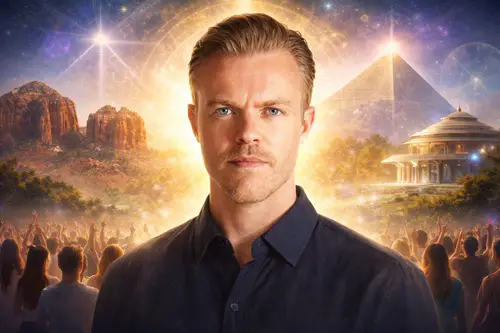 Introduction: A Digital-Age Guru EmergesBentinho Massaro represents a distinctly 21st-century spiritual phenomenon: the algorithm-friendly guru. Born in Amsterdam in 1988, he rose to prominence not through traditional lineages or institutions, but through YouTube, online courses, and social media amplification. His trajectory reflects a broader shift in spirituality away from monasteries and ashrams toward digital platforms, where charisma, accessibility, and personal branding can rapidly transform private insight into global influence. From Teenage Seeker to Spiritual EntrepreneurMassaro's early life follows a familiar New Age arc. Introduced at a young age to techniques like the Silva Method, he developed an early fascination with consciousness and paranormal abilities. A formative period in Rishikesh reportedly culminated in what he describes as an awakening experience—an encounter with nondual awareness that would later serve as the foundation of his teaching. Upon returning to the Netherlands, he began posting videos online, quickly gaining traction. By his early twenties, he had relocated to the United States, established the Trinfinity Academy, and begun organizing retreats. His ambitions were expansive from the outset, framed in terms of nothing less than an “enlightened civilization by 2035.” This fusion of mystical realization with entrepreneurial scaling is central to understanding both his appeal and his controversy. Teachings: Nonduality Meets Manifestation CultureMassaro's teachings synthesize several recognizable strands into a single, highly adaptable framework. At the core lies a nondual philosophy in which ultimate reality is understood as pure consciousness, directly accessible through realization rather than belief. This is combined with an emphasis on radical self-empowerment, where individuals are encouraged to take total responsibility for their experience and align themselves with higher “frequencies” of being. Layered onto this is a strong current of manifestation ideology, the notion that reality itself can be shaped through intention and alignment. These ideas are embedded within a broader, quasi-utopian vision of collective awakening, in which humanity evolves toward a higher state of consciousness. Unlike more traditional spiritual teachers, Massaro presents himself in an informal, irreverent style. He positions himself explicitly as “not your typical guru,” blending spiritual discourse with contemporary language, humor, and provocation. The resulting synthesis draws freely from Eastern philosophy, Western esotericism, self-help culture, and even speculative ideas about extraterrestrials and global transformation. This eclecticism is not accidental but reflects a broader New Age tendency to merge disparate domains into a unified, marketable worldview. The Mechanics of Rapid FameMassaro's rapid ascent can be understood in structural terms. Digital platforms allowed him to bypass traditional gatekeepers, giving him direct access to a global audience. His youth and Western background made him unusually relatable compared to older, more traditional gurus, while his fluency in contemporary idiom helped translate abstract spiritual concepts into accessible language. At the same time, he cultivated a strong sense of community through retreats, memberships, and online programs. These offerings created not just a following but an ecosystem, in which participants could deepen their engagement while also contributing financially. By the late 2010s, this ecosystem had become a significant enterprise, with high-priced courses and events forming a central component of his operation. In this sense, Massaro exemplifies a new model of spirituality in which personal branding and scalable business structures are integral to the dissemination of teachings. Controversies and ScandalsMassaro's career has been accompanied by persistent and serious controversies that have significantly shaped his public image. Journalistic investigations and testimonies from former followers have described what they characterize as a cult-like environment, marked by emotional manipulation, pressure to conform, and discouragement of critical thinking. Some accounts suggest that participants were urged to distance themselves from family or prior identities, raising concerns about psychological control. One of the most widely discussed incidents occurred in 2017, when a participant in a retreat in Sedona died by suicide after leaving the event. Although no legal charges were brought against Massaro, the incident intensified scrutiny of his teachings, particularly in light of statements he had made about death and transcendence. For critics, this raised broader questions about the ethical responsibilities of spiritual teachers when dealing with vulnerable individuals. Further allegations emerged in 2022, when former close associates accused him of psychological and emotional abuse, financial exploitation, and coercive sexual dynamics framed in spiritual terms. Massaro has denied these accusations, maintaining that all relationships were consensual and that his work has been misrepresented. Regardless of legal outcomes, these claims have had a substantial impact on his reputation and have deepened the divide between supporters and critics. In addition to these issues, Massaro has attracted criticism for statements that extend into more speculative or controversial territory, including claims about influencing weather, engaging with extraterrestrial intelligence, and endorsing certain conspiracy theories. For many observers, these elements reinforce concerns about grandiosity and a lack of epistemic discipline within his teaching. Devotees vs. Critics: A Polarized ReceptionThe reception of Massaro's work is sharply polarized. Supporters describe him as a powerful and articulate teacher capable of facilitating genuine awakening experiences. They emphasize the clarity of his communication and the transformative impact his teachings have had on their lives. Critics, by contrast, portray him as manipulative and narcissistic, a figure who exploits spiritual language for personal gain while fostering dependency among followers. Some view him as emblematic of a broader phenomenon in which digital platforms enable the rapid formation of guru-centered communities without the safeguards traditionally provided by established institutions. This polarization is not unusual in the history of charismatic spiritual figures, but it is intensified in Massaro's case by the speed and scale at which his message has spread online. A Structural Perspective: Why Figures Like Massaro EmergeFrom a broader analytical perspective, Massaro can be seen less as an anomaly than as a product of specific cultural conditions. Contemporary spirituality is increasingly individualistic, with authority shifting away from tradition and toward personal experience. At the same time, platform capitalism allows attention to be rapidly converted into influence and revenue, creating strong incentives for the cultivation of personal brands. In this context, the boundaries between insight, speculation, and fantasy can become blurred. Charisma and narrative coherence may function as substitutes for more rigorous forms of validation, enabling figures like Massaro to gain traction even when their claims extend beyond conventional epistemic limits. Conclusion: Insight, Inflation, and the Risks of Unchecked AuthorityBentinho Massaro's trajectory encapsulates both the promise and the peril of contemporary spirituality. His teachings engage with genuine existential questions about consciousness and identity, offering a framework that many find compelling and transformative. At the same time, his career illustrates how such frameworks can become entangled with issues of power, money, and psychological influence. The underlying tension is not unique to Massaro. It reflects a perennial problem in spiritual life: the challenge of balancing insight with accountability. In the digital age, however, this problem is amplified by the speed, reach, and monetization of influence. What his case ultimately underscores is the need for critical scrutiny. Claims of enlightenment, especially when combined with charisma and organizational authority, demand not passive acceptance but careful, sustained evaluation.
Comment Form is loading comments...
|