|
TRANSLATE THIS ARTICLE
Integral World: Exploring Theories of Everything
An independent forum for a critical discussion of the integral philosophy of Ken Wilber
  Frank Visser, graduated as a psychologist of culture and religion, founded IntegralWorld in 1997. He worked as production manager for various publishing houses and as service manager for various internet companies and lives in Amsterdam. Books: Ken Wilber: Thought as Passion (SUNY, 2003), and The Corona Conspiracy: Combatting Disinformation about the Coronavirus (Kindle, 2020). Frank Visser, graduated as a psychologist of culture and religion, founded IntegralWorld in 1997. He worked as production manager for various publishing houses and as service manager for various internet companies and lives in Amsterdam. Books: Ken Wilber: Thought as Passion (SUNY, 2003), and The Corona Conspiracy: Combatting Disinformation about the Coronavirus (Kindle, 2020).
Check out my other conversations with ChatGPT Ken Wilber's The Marriage of Sense and SoulA skeptical reviewFrank Visser / Claude
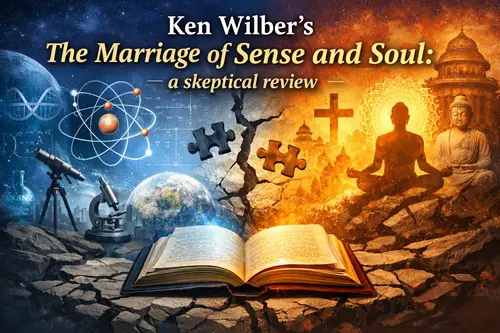 Ken Wilber's 1998 book sets itself an admirably clear task: to diagnose why every previous attempt to reconcile modern science with premodern religion has failed, and then to offer a solution that succeeds. The book is structured accordingly—Part I establishes the problem, Part II surveys and dismantles earlier integration attempts, Part III presents Wilber's own positive proposal. It is a genuinely well-organized argument, written with unusual clarity for a work of this ambition, and the critical sections of Part II are often sharp and compelling. The weaknesses, however, are deep, and they become most visible precisely where Wilber is most confident. The critique of previous approachesWilber's survey of failed integrations is one of the book's strongest sections. He identifies four broad camps: the "new paradigm" postmodernists, the Romantics, the German Idealists, and (briefly) those who confine themselves to epistemological pluralism. His critiques of each are often incisive. His demolition of the "new paradigm" approach—the popular notion, derived from a misreading of Thomas Kuhn, that science is just one paradigm among many and that a new "holistic" scientific paradigm will vindicate spirituality—is the most forensically satisfying part of the book. Wilber correctly points out that Kuhn used "paradigm" to mean specific experimental injunctions and social practices, not broad worldviews; that Kuhn himself counted hundreds of paradigm shifts, including the discovery of the battery; and that Kuhn was a committed believer in scientific progress who was appalled by the countercultural appropriation of his ideas. Wilber's further charge—that this misreading is self-contradictory (if all paradigms are equally valid, so is the paradigm that says they're not) and infected with what he calls "sixties narcissism"—is pointed, if somewhat uncharitable in tone. His critique of Romanticism is similarly well-constructed. The Romantics, Wilber argues, rightly identified the pathological dissociation of modernity's value spheres but wrongly diagnosed it as the result of differentiation itself. Having confused the two, they recommended regressing to a pre-differentiated state—back to nature, to the noble savage, to whatever premodern origin—when what was needed was to move forward to a higher integration. This confusion he calls the "pre/trans fallacy": the tendency to mistake pre-rational states for trans-rational ones simply because both are non-rational. Romantics elevated pre-conventional feeling and sensation as if they were the mystical summit of consciousness, when in fact genuine spiritual awareness (transrational) lies beyond rational modernity, not behind it. The evidence marshaled against the allegedly pristine premodern cultures the Romantics idealized—the warfare, slavery, and bride-price statistics in horticultural and foraging societies—makes this section of the book difficult to dismiss. The Idealists (Fichte, Schelling, Hegel) fare better in Wilber's assessment. They correctly understood that the integration had to move forward through developmental stages, not backward; they grasped evolution as "Spirit-in-action"; they tried to honor all three of modernity's differentiated value spheres (art, morals, science—Wilber's "Big Three"). But they failed, Wilber argues, for a specific and interesting reason: they had no yoga. Without a reliable set of reproducible interior practices—meditation traditions, contemplative disciplines—their transpersonal insights were haphazard, could not be transmitted reliably to others, and were inevitably dismissed as "mere metaphysics." Idealism talked about spiritual experience without being able to deliver it consistently. This is a genuinely interesting diagnosis, and more precise than most accounts of Idealism's decline. Wilber's own solutionHaving disposed of the alternatives, Wilber offers his positive proposal in Part III. Its core consists of two moves. The first is the "four quadrant" or AQAL framework: the claim that all holons (his term, borrowed from Koestler, for "whole/parts") have four irreducible dimensions—the interior individual (the "I" of subjective experience), the exterior individual (the "It" of biology and behavior), the interior collective (the "We" of culture and intersubjective meaning), and the exterior collective (the "It" of social systems). The disaster of modernity was the reduction of all four to the lower-right quadrant alone—exterior objective reality—what Wilber calls "flatland." The rehabilitation of the interior dimensions (upper-left and lower-left quadrants) is the precondition for any genuine integration of science and religion. The second move is his reconceptualization of the scientific method itself. Wilber argues that genuine science consists not of sensory empiricism specifically, but of three generic "strands of knowing": an injunction (do this, follow this procedure), an illumination (the data the procedure discloses), and a confirmation (checking results against a community of competent practitioners). He argues that contemplative traditions satisfy all three of these strands—meditation is the injunction, spiritual experience is the illumination, and communities of practitioners who have undergone the same training provide the confirmation. Therefore, "the eye of contemplation" has as much legitimate epistemic status as "the eye of flesh" (empirical science) or "the eye of mind" (rational-dialogical knowledge). Where the skepticism beginsThe four-quadrant framework is intellectually appealing, and Wilber's argument that a purely exterior account of reality cannot even explain science's own use of mathematics and logic has genuine philosophical force. Philosophers of science largely agree that naïve empiricism—the "myth of the given"—is untenable. So far, so good. The problems begin with the "three strands" argument. Wilber's claim that contemplative practice constitutes genuine empirical inquiry because it satisfies his three generic criteria rests on a critical equivocation. The word "confirmation" is doing enormous work that the framework quietly conceals. Scientific results are replicable not merely by members of a trained community, but in principle by anyone who follows the method regardless of prior belief, cultural context, or relationship to a teacher. The results are also convergent—independent investigators working in different traditions, with different background assumptions, typically arrive at compatible descriptions of the same phenomena. Contemplative "results" demonstrably fail both tests. A Zen practitioner who completes the process Wilber describes does not converge on the same description of reality as a Christian mystic, a Sufi, or an Advaita Vedantin who completes their tradition's practice. They arrive at anatta, or divine union with a personal God, or the identity of Atman and Brahman, or annihilation in the Beloved—descriptions that are not trivially compatible and that practitioners themselves have debated for millennia. Wilber has an answer to this: the apparent differences are the result of different stages of development, and the truly advanced traditions converge on "nondual" awareness at the highest level. But this answer is circular. The framework that ranks traditions by developmental level is already Wilber's own framework—itself derived, he claims, from the very contemplative sources whose validity he is trying to establish. The "no yoga" critique he levels at the Idealists also applies, more quietly, to his own project. Wilber does not himself present verified fruits of sustained contemplative practice in this book; he presents a theory about contemplative practice and its epistemological status. The book is, in this sense, more Idealist than it acknowledges. The hierarchy problem, restatedWilber's holarchical framework—where each stage of development "transcends and includes" its predecessors—is presented as neutral and descriptive, derived from an "extensive data search of several hundred hierarchies." But the hierarchies he collates are filtered through theoretical commitments he brings to the search. When he concludes that Western modernity's rational differentiation of the Big Three represents a higher stage than premodern cultures, and that nondual mystical awareness represents the summit above that, he is not neutrally reading off data from the world—he is mapping the world onto a framework that already privileges the kinds of knowing he finds most valuable. This is visible in the way he handles empirical inconveniences. The data about warfare in horticultural societies effectively demolishes the Romantic idealization of premodern life—Wilber wields these statistics with evident satisfaction. But he does not apply the same empirical ruthlessness to his own positive claims. The claim that advanced meditators reliably access a "nondual" awareness that transcends and resolves the contradictions between science and religion is treated as established; the question of what reproducible, independently verifiable evidence would support or falsify it is not seriously addressed. What survives scrutinyNone of this makes The Marriage of Sense and Soul a book without merit. The diagnosis of modernity's pathology—the collapse of the "Big Three" into a single monopoly of monological, exteriorizing, empirical science—draws on serious philosophical sources (Habermas, Charles Taylor, Weber's "disenchantment," Mumford's "disqualified universe") and is argued with real rigor. The pre/trans fallacy is a genuinely useful conceptual tool for analyzing why so many attempts to recover spiritual depth end up recommending regression rather than development. The critique of the "new paradigm" movement remains, nearly three decades later, fully applicable to its successors. The problem is that Wilber's positive proposal inherits the structural weakness he identified in the Idealists: it offers a compelling description of what an integration of science and religion would look like, and makes a sophisticated argument for why such an integration is possible in principle, without delivering the reliable, reproducible, independently verifiable spiritual epistemology that his own framework says is required. The marriage of sense and soul is announced but not consummated. The book is, ultimately, a very intelligent promissory note.
Comment Form is loading comments...
|