|
TRANSLATE THIS ARTICLE
Integral World: Exploring Theories of Everything
An independent forum for a critical discussion of the integral philosophy of Ken Wilber
  Frank Visser, graduated as a psychologist of culture and religion, founded IntegralWorld in 1997. He worked as production manager for various publishing houses and as service manager for various internet companies and lives in Amsterdam. Books: Ken Wilber: Thought as Passion (SUNY, 2003), and The Corona Conspiracy: Combatting Disinformation about the Coronavirus (Kindle, 2020). Frank Visser, graduated as a psychologist of culture and religion, founded IntegralWorld in 1997. He worked as production manager for various publishing houses and as service manager for various internet companies and lives in Amsterdam. Books: Ken Wilber: Thought as Passion (SUNY, 2003), and The Corona Conspiracy: Combatting Disinformation about the Coronavirus (Kindle, 2020).
Check out my other conversations with ChatGPT Ernst Mayr and the Architecture of Modern Evolutionary ThoughtFrank Visser / ChatGPT
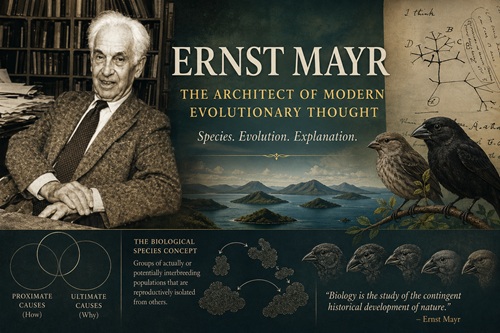 The relevance of Ernst Mayr lies not in any single discovery, but in the conceptual scaffolding he built for modern biology. Few twentieth-century scientists did more to clarify what evolution is, how species arise, and how biological explanation itself should be structured. His influence extends well beyond ornithology or systematics into the philosophy of biology, where he helped define the field's central questions. From Naturalist to Architect of the Modern SynthesisMayr began as a field naturalist, studying birds across the Pacific. This empirical grounding proved decisive. At a time when evolutionary theory was fragmented—split between geneticists, paleontologists, and naturalists—Mayr became one of the key figures in forging what is now called the Modern Synthesis. Alongside figures like Theodosius Dobzhansky and Julian Huxley, he helped integrate Mendelian genetics with natural selection. His 1942 book Systematics and the Origin of Species was pivotal. It reframed species not as static categories but as dynamic populations, thereby grounding evolution in population thinking rather than typological thinking. This shift remains foundational today. The Biological Species ConceptMayr's most enduring contribution is the Biological Species Concept. He defined species as groups of actually or potentially interbreeding populations that are reproductively isolated from others. This deceptively simple formulation redirected attention from morphology to reproductive isolation and gene flow. While later biologists have proposed alternative species concepts (phylogenetic, ecological, genomic), Mayr's formulation still serves as the default conceptual baseline. Even its critics operate within a framework he helped establish: that species are not merely classificatory conveniences but are evolutionary units. Allopatric Speciation and Geographic ThinkingMayr strongly emphasized allopatric speciation—the idea that new species arise when populations become geographically isolated. Drawing on his fieldwork in island biogeography, he argued that isolation allows genetic divergence to accumulate without homogenizing gene flow. Although contemporary research has expanded the picture to include sympatric and parapatric speciation, Mayr's geographic framing remains central. It grounded evolutionary theory in real-world ecological and spatial processes rather than abstract genetic models alone. Population Thinking vs. EssentialismOne of Mayr's most philosophically significant contributions was his critique of essentialism. He argued that biological reality is inherently variable and statistical, not defined by fixed essences. This “population thinking” stands in contrast to the typological mindset inherited from classical philosophy. In doing so, Mayr helped reshape not just biology but its epistemology. Biological explanations, he argued, must account for variation, contingency, and historical processes. This insight continues to inform debates about reductionism, emergence, and the autonomy of biology as a science. Proximate and Ultimate CausesMayr also introduced the influential distinction between proximate and ultimate causation. Proximate causes explain how a biological process works (mechanisms, physiology), while ultimate causes explain why it evolved (adaptive function, evolutionary history). This distinction remains a cornerstone of biological reasoning, particularly in fields like behavioral ecology and evolutionary psychology. It clarified persistent confusions between mechanism and function—confusions that still surface in public debates about evolution. Autonomy of BiologyMayr resisted the reduction of biology to physics or chemistry. He argued that biology deals with historically contingent systems shaped by natural selection, requiring its own explanatory frameworks. This position helped establish the philosophy of biology as a legitimate domain distinct from the philosophy of physics. His insistence on the autonomy of biological explanation is especially relevant today, as genomics and systems biology risk reviving overly reductionist interpretations of life. Limits and CritiquesMayr's framework is not without limitations. His emphasis on gradualism and allopatric speciation arguably downplayed other evolutionary mechanisms. Later developments—neutral theory, evo-devo, and genomic insights—have complicated the synthesis he helped build. Moreover, his strong defense of adaptationism has been challenged by figures like Stephen Jay Gould, who argued that not all traits are adaptive. Yet even these critiques operate within a conceptual terrain that Mayr helped define. Enduring RelevanceMayr's relevance today is methodological as much as theoretical. He clarified what counts as a biological explanation, distinguished levels of causation, and grounded evolutionary theory in population-level processes. In an era where evolutionary biology interfaces with genetics, ecology, and even cultural debates, this conceptual clarity remains indispensable. If Darwin provided the initial framework, Mayr helped stabilize and articulate it for modern science. His work reminds us that progress in science is not only about new data but about organizing principles—about seeing clearly what kind of questions we are asking, and what kind of answers count. Appendix: Ken Wilber and the Misreading of MayrThe engagement of Ken Wilber with evolutionary biology, including his references to Ernst Mayr, illustrates a recurring problem: the translation of scientific concepts into a metaphysical narrative that subtly alters their meaning. At the center of this misreading is Mayr's distinction between proximate and ultimate causation. For Mayr, “ultimate” causes are strictly evolutionary explanations—historical accounts of how natural selection shaped a trait. They are not teleological in a metaphysical sense. They do not imply foresight, intention, or cosmic directionality. Wilber, however, tends to reinterpret “ultimate” causation as if it pointed toward intrinsic purpose or even a kind of immanent drive toward higher complexity—what he elsewhere frames as Eros or Spirit-in-action. This move effectively reintroduces teleology under a scientific label, blurring the boundary Mayr worked carefully to maintain. A similar distortion appears in Wilber's treatment of natural selection. Where Mayr emphasized selection acting on variation within populations—without foresight or intrinsic direction—Wilber often portrays evolution as a progressive unfolding toward greater depth, consciousness, or integration. While such narratives can be philosophically suggestive, they are not derived from Mayr's framework and, in fact, run counter to its core commitments. Mayr explicitly rejected vitalism and any form of internally driven evolutionary force. His population thinking denies the existence of pre-given essences or directional tendencies in nature. Evolution, in his account, is opportunistic, contingent, and historically constrained. Wilber's model, by contrast, relies on a quasi-teleological gradient of development, which sits uneasily with Mayr's anti-essentialist stance. The result is not simply a disagreement but a category error. Scientific concepts designed to explain empirical processes are repurposed to support metaphysical claims. This creates the impression of continuity between evolutionary biology and spiritual philosophy where, in fact, there is a methodological discontinuity. To be precise: Wilber is not obliged to accept Mayr's naturalism. He is free to propose a metaphysical interpretation of evolution. The problem arises when that interpretation is presented as if it were supported by, or continuous with, the biological framework Mayr helped construct. In that sense, Mayr's relevance extends even into this debate. His careful distinctions—between proximate and ultimate causes, between population thinking and essentialism, between mechanism and teleology—provide exactly the tools needed to diagnose where such reinterpretations depart from scientific reasoning.
Comment Form is loading comments...
|