|
TRANSLATE THIS ARTICLE
Integral World: Exploring Theories of Everything
An independent forum for a critical discussion of the integral philosophy of Ken Wilber
  Frank Visser, graduated as a psychologist of culture and religion, founded IntegralWorld in 1997. He worked as production manager for various publishing houses and as service manager for various internet companies and lives in Amsterdam. Books: Ken Wilber: Thought as Passion (SUNY, 2003), and The Corona Conspiracy: Combatting Disinformation about the Coronavirus (Kindle, 2020). Frank Visser, graduated as a psychologist of culture and religion, founded IntegralWorld in 1997. He worked as production manager for various publishing houses and as service manager for various internet companies and lives in Amsterdam. Books: Ken Wilber: Thought as Passion (SUNY, 2003), and The Corona Conspiracy: Combatting Disinformation about the Coronavirus (Kindle, 2020).
Check out my other conversations with ChatGPT Karl Popper and DarwinismFrom Skepticism to Qualified EndorsementFrank Visser / ChatGPT
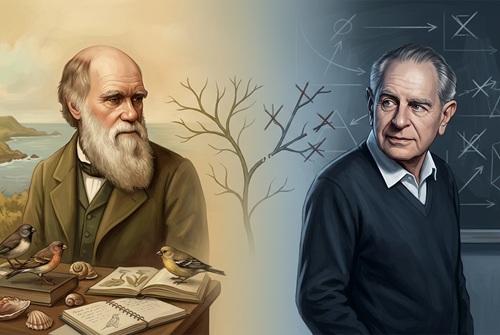 The Problem of DemarcationAt the core of Karl Popper's philosophy lies a single, stringent question: what distinguishes science from non-science? His answer—falsifiability—was developed most systematically in The Logic of Scientific Discovery. A theory counts as scientific if it exposes itself to potential refutation by empirical evidence. The more a theory risks being proven wrong, the more scientifically valuable it is. This criterion became Popper's evaluative lens for all major theories, including Darwinian evolution. Early Skepticism: Darwinism as a “Metaphysical Research Programme”In his earlier writings, Popper expressed doubts about the scientific status of Darwinism. He famously suggested that the theory of natural selection might function as a “metaphysical research programme” rather than a strictly testable scientific theory. His concern centered on the apparent tautology embedded in the phrase “survival of the fittest.” If “fitness” is defined in terms of survival, then the statement reduces to: those who survive are those who survive. In that case, no conceivable observation could falsify the theory, since any evolutionary outcome could be retrospectively explained. For Popper, this was a red flag. A theory that accommodates every possible outcome risks collapsing into explanatory vacuity. The Charge of Tautology ExaminedPopper's critique, while influential, arguably targeted an oversimplified version of Darwinism. The slogan “survival of the fittest” is not how working biologists operationalize evolutionary theory. In practice, “fitness” is defined independently—typically in terms of reproductive success within specific environmental contexts. Once framed this way, evolutionary hypotheses become testable. For example, predictions about how certain traits will fare under defined ecological pressures can be empirically assessed. The apparent tautology dissolves when the theory is embedded in measurable biological parameters. Popper's Revision: A More Favorable AssessmentPopper later acknowledged that his earlier critique had been overstated. In Objective Knowledge: An Evolutionary Approach and subsequent clarifications, he conceded that Darwinian theory does generate falsifiable hypotheses when properly formulated. He came to see natural selection not as a closed logical system but as part of a broader scientific framework enriched by genetics, ecology, and experimental biology. Within this expanded context, evolutionary theory produces risky predictions and is subject to empirical testing. This marked a significant shift: from regarding Darwinism as borderline metaphysical to recognizing it as a robust, if complex, scientific research programme. Evolutionary Epistemology: Convergence with DarwinInterestingly, Popper's own philosophy began to mirror evolutionary logic. He developed “evolutionary epistemology,” the idea that knowledge evolves through a process of conjectures and refutations. Hypotheses are proposed, subjected to critical testing, and eliminated if falsified. This model closely parallels Darwinian selection. Scientific theories, in Popper's view, compete for survival in an environment defined by empirical scrutiny. Those that withstand testing persist; those that fail are discarded. In this sense, Popper did not merely accept Darwinism—he internalized its logic into his philosophy of knowledge. Misuse and MisinterpretationDespite Popper's later revisions, his early remarks continue to be cited—often selectively—by critics of evolution. By ignoring his subsequent clarifications, such interpretations create the impression that Popper ultimately rejected Darwinism. This is inaccurate. His mature position is better described as critical but affirming: he recognized limitations in overly loose formulations of natural selection, yet accepted its scientific legitimacy when properly specified. Conclusion: From Demarcation to PracticePopper's engagement with Darwinism reveals an important philosophical shift. His initial application of a strict demarcation criterion led him to underestimate the empirical richness of evolutionary biology. Over time, he moved toward a more practice-oriented understanding of science, one that acknowledges how theories function within complex research traditions. Darwinism, viewed through this lens, is not a tautological slogan but a dynamic and testable framework. Popper's intellectual journey—from skepticism to qualified endorsement—underscores a broader lesson: the scientific status of a theory depends less on its abstract formulation than on how it operates in empirical inquiry. Addendum: The Falsifiability Problem with “Eros”Eros as a Causal PrincipleWithin certain strands of integral and spiritualized evolutionary thought—most prominently associated with Ken Wilber—“Eros” is invoked as an intrinsic drive toward greater complexity, consciousness, and organization. It is presented not merely as metaphor, but as a quasi-causal force immanent in the evolutionary process. This move shifts the explanatory register. Instead of relying solely on mechanisms such as variation, selection, drift, and constraint, evolution is said to be guided—or at least biased—by an underlying directional impulse. The Popperian ChallengeFrom the standpoint of Karl Popper's philosophy of science, the immediate question is straightforward: what would count as a falsification of Eros? A scientific hypothesis must exclude certain possible states of affairs. It must take risks. If Eros is posited as a universal drive toward complexity, then we must ask: what empirical observation would demonstrate that this drive does not exist? Here the difficulty becomes apparent. The Elasticity of ErosEros is typically defined in highly elastic terms. When evolution produces increasing complexity—multicellularity, nervous systems, intelligence—this is cited as evidence for Eros. But when evolution yields simplicity, stagnation, or extinction, these outcomes are not taken as counterevidence. Instead, they are reinterpreted: • Simplicity becomes a “necessary regression” • Extinction becomes “part of the larger unfolding” • Randomness becomes “Eros working through contingency” In effect, every possible evolutionary outcome is assimilated into the framework. This is precisely the pattern Popper warned against: a theory that explains everything by accommodating anything. Comparison with Darwinian MechanismsStandard Darwinian theory, associated with Charles Darwin, does not posit a directional force toward complexity. Evolution can produce greater complexity, but it can just as readily produce simplification—parasites losing organs, cave fish losing eyesight, lineages stagnating for millions of years. Crucially, Darwinian explanations are locally testable. One can formulate hypotheses about selective pressures, environmental constraints, and genetic variation, and then evaluate these against empirical data. The theory does not guarantee progress; it predicts contingent outcomes.
Eros, by contrast, functions as a global interpretive overlay rather than a locally testable mechanism. The Tautology RiskThe structure of the Eros claim closely mirrors the tautology Popper initially worried about in Darwinism: Darwin (misinterpreted): “Those who survive are the fittest.” Eros: “Evolution goes where it goes because it is driven by Eros.” In both cases, the explanatory term risks collapsing into a restatement of the outcome. However, Darwinian theory escapes this trap through operationalization—fitness is measured independently. Eros lacks such operational criteria. Without independent metrics, “Eros” becomes indistinguishable from the very phenomena it seeks to explain. Immunization StrategiesEros-based frameworks often employ what Popper called “immunizing strategies”—moves that protect a theory from refutation: • Scope expansion: redefining Eros to include all outcomes • Level shifting: relocating Eros to a “deeper” or “subtle” realm when empirical evidence is lacking • Teleological reframing: interpreting all processes as goal-directed, regardless of observable mechanisms These strategies preserve the theory at the cost of its empirical content. Metaphysics vs. ScienceThis does not necessarily render Eros meaningless. It may still function as a metaphysical or symbolic principle—a way of expressing a worldview about directionality, meaning, or value in the cosmos. But in Popperian terms, this reclassification is decisive. Eros would belong not to empirical science but to metaphysics: a domain that can inspire inquiry but is not itself subject to empirical testing. Popper himself allowed for such metaphysical ideas, provided they are not conflated with scientific explanations. Conclusion: An Unfalsifiable AttractorThe appeal of Eros is understandable. It offers a narrative of direction, purpose, and ascent—features that resonate with human intuitions about progress and meaning. But this very flexibility undermines its scientific status. From a Popperian perspective, Eros functions as an unfalsifiable attractor: it draws all evidence into its orbit without ever risking contradiction. As such, it may guide interpretation, but it cannot serve as an explanatory principle in the rigorous, testable sense that defines science. In this respect, the contrast with Darwinian evolution becomes sharp. Where Darwin offers a constrained, testable framework grounded in contingency, Eros provides a totalizing narrative that explains too much—and therefore, in the strict sense, explains too little.
Comment Form is loading comments...
|