|
TRANSLATE THIS ARTICLE
Integral World: Exploring Theories of Everything
An independent forum for a critical discussion of the integral philosophy of Ken Wilber
  Frank Visser, graduated as a psychologist of culture and religion, founded IntegralWorld in 1997. He worked as production manager for various publishing houses and as service manager for various internet companies and lives in Amsterdam. Books: Ken Wilber: Thought as Passion (SUNY, 2003), and The Corona Conspiracy: Combatting Disinformation about the Coronavirus (Kindle, 2020). Frank Visser, graduated as a psychologist of culture and religion, founded IntegralWorld in 1997. He worked as production manager for various publishing houses and as service manager for various internet companies and lives in Amsterdam. Books: Ken Wilber: Thought as Passion (SUNY, 2003), and The Corona Conspiracy: Combatting Disinformation about the Coronavirus (Kindle, 2020).
Check out my other conversations with ChatGPT Carlo RovelliPhysics, Philosophy, and Public ImaginationFrank Visser / ChatGPT
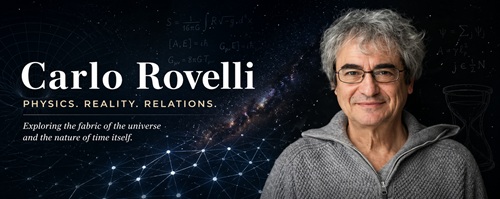 Carlo Rovelli occupies a distinctive position in contemporary theoretical physics. He is neither a mainstream consensus-builder in the mold of high-energy particle physicists nor a fringe outsider. Instead, he operates in a hybrid zone: a technically respected researcher, a founder of a major alternative program in quantum gravity, and a rare figure whose philosophical reflections and popular writings have reached a global audience. His relevance lies precisely in this triangulation—between formal physics, conceptual analysis, and cultural communication. Scientific Contributions: Loop Quantum GravityRovelli's primary scientific legacy is his role in developing Loop Quantum Gravity (LQG), one of the leading non-string approaches to unifying General Relativity with Quantum Mechanics. LQG attempts to quantize spacetime itself, proposing that space is not continuous but composed of discrete, network-like structures at the Planck scale. Technically, this approach is notable for being background independent, meaning it does not assume a fixed spacetime geometry but instead derives geometry from quantum relations. It offers a mathematically coherent framework and has generated concrete results, for example in black hole thermodynamics and early-universe cosmology. However, like all quantum gravity programs, LQG faces a fundamental limitation: the absence of experimental confirmation. As Rovelli himself emphasizes, the relevant scales are so small that direct empirical tests remain out of reach, forcing evaluation to rely on internal consistency and conceptual plausibility rather than decisive data. Conceptual Innovation: Time, Relationalism, and OntologyRovelli's importance extends beyond technical physics into foundational questions. He is a leading advocate of a relational interpretation of reality, both in quantum mechanics and in spacetime theory. In his view, physical properties do not exist absolutely but only relative to interactions. One of his most provocative claims concerns time. In LQG-inspired interpretations, time may not exist as a fundamental entity. Instead, reality is described in terms of processes and relations without a universal temporal flow. Philosophers analyzing his work argue that this leads to a “process metaphysics” in which change is fundamental but time is not. This places Rovelli in a lineage that blends physics with philosophical revisionism. He does not merely solve equations; he challenges the conceptual scaffolding inherited from classical physics. Public Intellectual: Popular Science and Cultural ReachUnlike many theoretical physicists, Rovelli has achieved substantial influence outside academia. His books—especially Seven Brief Lessons on Physics—have been translated into dozens of languages and reached a mass readership. His writing style is notable for its literary quality, often blending science with references to philosophy, poetry, and even Dante Alighieri. Reviews of his later work, such as White Holes, note that it sometimes reads “more like poetry than a science lesson,” emphasizing imagination as part of scientific understanding. This public-facing dimension amplifies his relevance. Rovelli is one of the few physicists shaping not just specialist debates but broader cultural perceptions of science, time, and reality. Reception Within Physics: Respect and SkepticismRovelli's reception within the physics community is mixed, reflecting both scientific and sociological factors. On one hand, he is widely regarded as a serious and accomplished physicist. He leads a major research group, has produced influential papers, and helped establish an entire research program. On the other hand, his central project—loop quantum gravity—remains a minority approach compared to String Theory. The field of quantum gravity is fragmented, and different communities often pursue competing paradigms with limited convergence. Rovelli himself has acknowledged that these approaches are shaped not only by evidence but by differing “scientific prejudices” and research cultures. Critically, LQG is sometimes viewed as less developed in terms of unification or predictive power than string theory, while string theory itself is criticized for its lack of empirical testability. The result is a theoretical landscape where no approach has achieved decisive dominance. This ambiguity shapes Rovelli's reception: respected as a thinker, but associated with a program that has not (yet) delivered empirical breakthroughs. Reception Beyond Physics: Admiration and AmbivalenceOutside academia, Rovelli is often admired for his clarity and philosophical depth. Readers and commentators frequently highlight his ability to make abstract physics intelligible and meaningful. At the same time, this accessibility creates a tension. His philosophical extrapolations—about time, reality, and relational existence—are sometimes embraced enthusiastically by broader audiences while being treated more cautiously by working physicists, who tend to prioritize calculational utility over ontological speculation. In this sense, Rovelli's reception mirrors a broader divide: between physics as a technical discipline and physics as a source of metaphysical insight. Assessment: Why Rovelli MattersRovelli's relevance can be distilled into three domains. First, he is a central figure in one of the few serious alternatives to string theory, ensuring pluralism in the search for quantum gravity. Second, he reopens foundational questions—about time, reality, and relations—that many physicists sideline but which remain conceptually unavoidable. Third, he acts as a bridge between science and culture, shaping how non-specialists understand modern physics. The unresolved status of his scientific program does not diminish this relevance. On the contrary, it highlights the current state of fundamental physics itself: a field rich in theory, poor in experimental guidance, and therefore unusually open to conceptual innovation. In that landscape, Rovelli stands out—not as the definitive voice of the future, but as one of the clearest articulators of its possibilities and its uncertainties. Appendix: Major Schools of Physics and Their ImportanceModern physics is not a monolithic enterprise but a constellation of partially overlapping research programs, each defined by its mathematical framework, empirical domain, and ontological commitments. What follows is a structured overview of the major schools, with an emphasis on their conceptual stakes and current relevance. Classical PhysicsAssociated with figures like Isaac Newton and James Clerk Maxwell, classical physics encompasses Newtonian mechanics, classical electromagnetism, and thermodynamics. Its importance lies in its enduring applicability: most engineering, astrophysics, and macroscopic modeling still rely on classical equations. Conceptually, it established determinism, continuity, and objectivity as default assumptions about nature—assumptions later challenged but never entirely abandoned. RelativityDeveloped by Albert Einstein, relativity comes in two forms: Special Relativity and General Relativity. The latter remains the standard theory of gravitation. Its importance is both empirical and conceptual. Empirically, it explains phenomena from GPS corrections to black holes. Conceptually, it replaces absolute space and time with a dynamical spacetime geometry, setting the stage for all modern cosmology. Quantum MechanicsFounded through the work of Niels Bohr, Werner Heisenberg, and Erwin Schrödinger, quantum mechanics governs microscopic phenomena. Its importance is unmatched in terms of predictive success. It underpins chemistry, materials science, and modern technology (semiconductors, lasers). Conceptually, it introduces indeterminacy, observer-dependence, and probabilistic ontology—features that continue to provoke interpretive debates. Quantum Field Theory and the Standard ModelQuantum Field Theory (QFT) merges quantum mechanics with special relativity. Its most successful realization is the Standard Model of particle physics. Key contributors include Richard Feynman and Steven Weinberg. Its importance lies in its precision: predictions match experiments to extraordinary accuracy. It describes three of the four fundamental forces (excluding gravity) and classifies all known elementary particles. However, it is widely regarded as incomplete, leaving gravity and dark matter unexplained. Statistical MechanicsDeveloped by Ludwig Boltzmann and Josiah Willard Gibbs, this framework connects microscopic laws with macroscopic phenomena. Its importance is methodological: it explains how thermodynamic behavior emerges from large ensembles of particles. It also introduces probability as a bridge between determinism and observed irreversibility (entropy). Condensed Matter PhysicsThis is the physics of solids and liquids, focusing on collective behavior in many-body systems. While less philosophically glamorous, it is arguably the most productive field in terms of real-world impact—leading to superconductors, semiconductors, and nanotechnology. Conceptually, it demonstrates that entirely new “emergent” laws can arise at higher levels of complexity, independent of fundamental particle physics. CosmologyModern cosmology applies general relativity and quantum theory to the universe as a whole. Key developments include the Big Bang model, cosmic inflation, and dark energy. Its importance lies in addressing ultimate-scale questions: the origin, structure, and fate of the universe. It is also one of the few areas where theoretical physics interfaces directly with large-scale observational data. Quantum Gravity ProgramsHere we enter the most speculative frontier, where Carlo Rovelli becomes especially relevant. There are several competing schools: • Loop Quantum Gravity (LQG) – Associated with Rovelli, it posits a discrete structure of spacetime and emphasizes background independence. • String Theory – Associated with figures like Edward Witten, it models fundamental entities as one-dimensional strings and aspires to a unified “theory of everything.” • Causal Dynamical Triangulations, Asymptotic Safety, and others – Smaller but active programs exploring alternative quantizations of gravity. Their importance is primarily conceptual at present. They attempt to resolve the incompatibility between general relativity and quantum mechanics, but none has yet achieved empirical validation. Foundations and Interpretations of Quantum MechanicsThis school is less about new equations and more about what existing equations mean. Competing interpretations include: • Copenhagen interpretation • Many-Worlds interpretation • Relational quantum mechanics (associated with Carlo Rovelli) • Objective collapse theories Its importance is philosophical but not trivial. Interpretations shape how physicists think about measurement, reality, and information, even if they rarely alter experimental predictions. Complex Systems and Nonlinear DynamicsThis interdisciplinary school studies systems where simple rules produce unpredictable or emergent behavior. It includes chaos theory, network science, and systems biology. Its importance lies in extending physics beyond reductionism, addressing phenomena like turbulence, ecosystems, and even social systems. Information-Theoretic and Computational PhysicsA newer and rapidly growing perspective treats information as fundamental. Influenced by quantum information theory, it reframes physics in terms of computation, entropy, and information flow. Its importance is twofold: it drives technological advances (quantum computing) and may offer new conceptual foundations for physics itself. Concluding PerspectiveThese schools are not mutually exclusive; they form a layered hierarchy. Classical physics survives within relativity, which in turn coexists uneasily with quantum theory, while quantum gravity seeks their unification. The fragmentation at the frontier—especially in quantum gravity—reveals a discipline in a state of productive uncertainty. In that landscape, figures like Carlo Rovelli are important not because they have resolved these tensions, but because they articulate coherent alternatives within them. Physics today is less a finished edifice than an active construction site.
Comment Form is loading comments...
|