|
TRANSLATE THIS ARTICLE
Integral World: Exploring Theories of Everything
An independent forum for a critical discussion of the integral philosophy of Ken Wilber
  Frank Visser, graduated as a psychologist of culture and religion, founded IntegralWorld in 1997. He worked as production manager for various publishing houses and as service manager for various internet companies and lives in Amsterdam. Books: Ken Wilber: Thought as Passion (SUNY, 2003), and The Corona Conspiracy: Combatting Disinformation about the Coronavirus (Kindle, 2020). Frank Visser, graduated as a psychologist of culture and religion, founded IntegralWorld in 1997. He worked as production manager for various publishing houses and as service manager for various internet companies and lives in Amsterdam. Books: Ken Wilber: Thought as Passion (SUNY, 2003), and The Corona Conspiracy: Combatting Disinformation about the Coronavirus (Kindle, 2020).
Check out my other conversations with ChatGPT David Ray Griffin and 9/11When Philosophical Skepticism Meets Conspiratorial ThinkingFrank Visser / ChatGPT
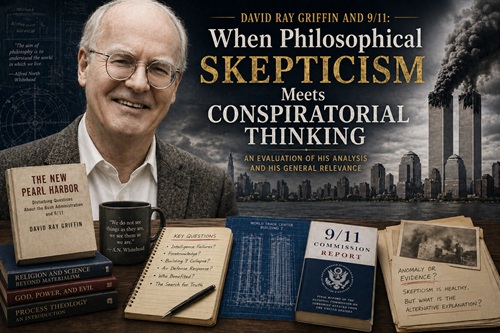 The Unlikely Convergence of Philosophy and ControversyDavid Ray Griffin occupies a distinctive and somewhat paradoxical position in contemporary intellectual life. A respected scholar in process philosophy, deeply shaped by the metaphysical vision of Alfred North Whitehead, Griffin built his early career on rigorous engagements with science, religion, and metaphysics. Yet he later emerged as a prominent critic of the official account of the September 11 attacks—a move that significantly altered how his work is perceived both inside and outside academia. This dual identity—serious philosopher and controversial public intellectual—makes Griffin an instructive case for evaluating the boundaries of legitimate skepticism. The New Pearl Harbor: A Philosophical Critique of 9/11In The New Pearl Harbor (2004), Griffin sets out to challenge the U.S. government's explanation of 9/11. His strategy is not to present a single decisive counter-theory, but to accumulate what he sees as a pattern of unresolved anomalies: intelligence warnings that were ignored, irregularities in air defense responses, and the collapse dynamics of World Trade Center buildings, especially Building 7. Griffin's argumentative style is recognizably philosophical. He emphasizes internal consistency, evidential coherence, and inference to the best explanation. The tone is measured, the documentation extensive, and the structure cumulative. This gives the work an appearance of scholarly seriousness that distinguishes it from more overtly speculative conspiracy literature. The Problem of Selective SkepticismThe central weakness of Griffin's analysis lies not in his willingness to question official accounts, but in how that skepticism is distributed. His approach tends to magnify anomalies while minimizing the explanatory power of established investigations. Large-scale events like 9/11 inevitably generate confusion, conflicting reports, and incomplete data. Griffin treats these features as evidence of deliberate deception rather than as predictable byproducts of complexity. This reflects a form of selective skepticism: official explanations are subjected to intense scrutiny, while alternative interpretations are granted plausibility on comparatively modest grounds. Crucially, many of the technical issues Griffin raises—such as building collapses—have been extensively analyzed by bodies like the National Institute of Standards and Technology and the 9/11 Commission. Griffin often dismisses these findings wholesale, rather than engaging them at the level of competing technical models. The result is an evidential asymmetry that undermines the credibility of his conclusions. From Anomalies to Conspiracy: A Logical LeapA recurring pattern in Griffin's reasoning is the inference that flaws in the official narrative increase the likelihood of a deeper, coordinated conspiracy. This move is philosophically problematic. Pointing out inconsistencies in one explanation does not automatically validate another—especially when the alternative involves large-scale, coordinated deception across multiple institutions. Such claims require robust, independent evidence, not merely the accumulation of unresolved questions. In epistemological terms, Griffin's argument risks conflating underdetermination (multiple possible explanations) with confirmation (evidence favoring a specific one). Intellectual Roots: Process Thought and Suspicion of OrthodoxyTo understand Griffin's trajectory, one must situate it within his broader intellectual commitments. Influenced by Alfred North Whitehead, Griffin consistently challenged reductionist and materialist frameworks. His work in process theology reflects a broader ambition to rethink the relationship between science, metaphysics, and spirituality. This orientation fosters a healthy critical stance toward dominant paradigms. However, when extended into empirical domains requiring specialized technical expertise, it can drift into generalized distrust. In Griffin's case, skepticism toward materialism appears to have evolved into skepticism toward institutional knowledge more broadly. A Divided LegacyGriffin's legacy is, therefore, sharply divided. Within process philosophy and theology, he remains a significant and respected figure whose contributions continue to shape ongoing debates. His work in these areas retains intellectual value and relevance. In contrast, his 9/11 writings have largely marginalized him in the eyes of the wider academic community. For many scholars, they illustrate how methodological rigor can erode when one operates outside one's domain of expertise without adopting the standards of the relevant disciplines. Conclusion: A Cautionary Intellectual TrajectoryDavid Ray Griffin's engagement with 9/11 is not without value. It underscores the importance of critical inquiry and the need to scrutinize official narratives. But it also demonstrates the risks of unbalanced skepticism—where the impulse to question becomes detached from the discipline required to evaluate competing claims. His work ultimately stands less as a convincing alternative account of 9/11 than as a case study in epistemology: how intelligent, well-trained thinkers can arrive at controversial conclusions when evidential standards are unevenly applied. Griffin remains relevant, but in a dual sense—both as a contributor to process thought and as a cautionary example of how intellectual credibility can be strained when skepticism outpaces substantiation. Appendix: How Did Ken Wilber “Explain” 9/11?Ken Wilber did not engage the September 11 attacks in the forensic or evidential manner that David Ray Griffin attempted. There is no Wilberian equivalent of The New Pearl Harbor, no detailed reconstruction of timelines, intelligence failures, or engineering debates. Instead, Wilber approached 9/11 as a civilizational and psychological event, to be interpreted through the lens of Integral Theory. A Developmental Diagnosis: Levels of ConsciousnessWilber's primary explanatory tool is his developmental model of consciousness—often framed in terms of stages such as archaic, magic, mythic, rational, and pluralistic. In his post-9/11 writings, he interprets Islamist extremism as an expression of “mythic-membership” consciousness.[1] Within this framework, the attackers are not primarily analyzed as geopolitical actors but as representatives of a pre-modern worldview—one that absolutizes belief systems, divides the world into in-groups and out-groups, and legitimizes violence in defense of sacred narratives. The West, by contrast, is portrayed as largely operating at rational and pluralistic stages, though not without its own pathologies. This is less an explanation of what happened than of what kind of minds could produce such actions. The AQAL Lens: Multiple Dimensions, Uneven DepthWilber's broader AQAL model (“all quadrants, all levels”) would, in principle, require attention to: • Interior (psychological, cultural) dimensions • Exterior (behavioral, institutional) dimensions • Individual and collective levels In practice, however, critics have noted that his treatment of 9/11 is heavily weighted toward the interior-collective quadrant—that is, cultural worldviews and belief systems. Geopolitical history, intelligence structures, and material causation receive comparatively little attention. This creates a kind of explanatory imbalance: the attacks are interpreted primarily as the eruption of a regressive consciousness structure, rather than as the outcome of complex historical, political, and strategic dynamics. Good vs. Evil—Reframed, Not RemovedWilber often resists simplistic moral binaries, yet his framing of 9/11 introduces a subtler version of the same dichotomy. “Mythic” consciousness is depicted as inherently prone to absolutism and violence, while “higher” stages are associated with tolerance and integration. The result is a developmental moral hierarchy that risks oversimplifying the situation. It downplays, for example, how modern and postmodern actors—including Western states—can also engage in large-scale violence, albeit justified through different narratives (e.g., security, democracy, humanitarian intervention). Contrast with Griffin: Interior Meaning vs. Exterior CausationThe contrast with David Ray Griffin is instructive: Griffin focuses on external anomalies and institutional behavior, attempting to challenge the official narrative. Wilber focuses on internal worldviews and developmental stages, largely accepting the mainstream account of events. Where Griffin risks overinterpreting anomalies as evidence of conspiracy, Wilber risks underinterpreting the empirical complexity by subsuming it under a broad psychological schema. Critique: The Limits of Integral ExplanationWilber's approach offers a certain kind of insight—it highlights the role of belief systems, identity structures, and cultural development in shaping human conflict. But as an explanation of 9/11, it is abstract to the point of detachment. It does not address: • The operational specifics of the attacks • Intelligence failures • The geopolitical context of U.S.-Middle East relations • The strategic aims of groups like al-Qaeda Instead, it provides a meta-framework—a way of categorizing types of consciousness involved—without engaging deeply with the empirical details that historians, political scientists, and investigators consider essential. Conclusion: A Meaning-Making System, Not an InvestigationWilber did not so much explain 9/11 as interpret it within a pre-existing philosophical architecture. His account operates at the level of meaning, not mechanism; at the level of worldview, not evidence. This makes it complementary, in a loose sense, to Griffin's approach—but also highlights a shared limitation. Both thinkers, in different ways, filter 9/11 through overarching frameworks—process philosophy in one case, Integral Theory in the other—rather than fully submitting their interpretations to the constraints of empirical, multidisciplinary investigation. In that sense, Wilber's “explanation” tells us more about Integral Theory than it does about 9/11 itself. Further Reading[1] Ken Wilber, "The Deconstruction of the World Trade Center: A Date That Will Live in a Sliding Chain of Signifiers", www.integrallife.com (members-only) Ken Wilber explores the many sorts of reactions people had to the tragedy of 9/11, and offers a theoretical framework within which a genuinely Integral approach to politics and governance might emerge. Note the qualification "genuine integral approach" in the promo copy on Integral Life. The above essay strongly questions this, as it pertains only to the left-hand quadrants.
Comment Form is loading comments...
|