|
TRANSLATE THIS ARTICLE
Integral World: Exploring Theories of Everything
An independent forum for a critical discussion of the integral philosophy of Ken Wilber
  Frank Visser, graduated as a psychologist of culture and religion, founded IntegralWorld in 1997. He worked as production manager for various publishing houses and as service manager for various internet companies and lives in Amsterdam. Books: Ken Wilber: Thought as Passion (SUNY, 2003), and The Corona Conspiracy: Combatting Disinformation about the Coronavirus (Kindle, 2020). Frank Visser, graduated as a psychologist of culture and religion, founded IntegralWorld in 1997. He worked as production manager for various publishing houses and as service manager for various internet companies and lives in Amsterdam. Books: Ken Wilber: Thought as Passion (SUNY, 2003), and The Corona Conspiracy: Combatting Disinformation about the Coronavirus (Kindle, 2020).
Check out my other conversations with ChatGPT Reaching Out to the WorldThe Promise and Problems of Integral TheoryFrank Visser / ChatGPT
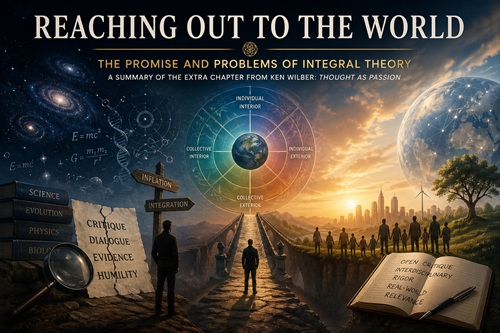 From Vision to Institution: The Rise of the Integral MovementIn this later reflective chapter, "Reaching Out to the World", Frank Visser shifts from descriptive exposition to critical assessment of Ken Wilber's Integral Theory. He begins by examining the ambitious institutional expansion following the founding of the Integral Institute in the late 1990s. The movement sought to establish itself across domains—education, politics, medicine, ecology—branding “integral” as a unifying framework for knowledge and practice. Yet these ambitions largely exceeded their execution. Planned academic textbooks, research programs, and institutional footholds failed to materialize or endure. Visser emphasizes a key tension: science is inherently collaborative, but Integral Theory remained dependent on Wilber as its central intellectual authority. This lack of broader scholarly validation limited its academic credibility. A Missed Opportunity: Integral Theory and Global CrisesThe attacks of September 11 attacks provided a real-world test case for Integral Theory's relevance. Visser argues that Wilber's response—presented through fictionalized narratives rather than direct analysis—undermined its potential impact. Instead of engaging policymakers or the broader intellectual public, Wilber's approach remained insular and stylistically inaccessible. Wilber's interpretive framework reduced responses to 9/11 to developmental stages of consciousness, culminating in a detached spiritual perspective that could even question whether there was a “crisis” at all. For Visser, this exemplified a broader failure: Integral Theory did not meaningfully enter public discourse where it might have demonstrated practical value. Conflict and Closure: The Problem of CriticismA central theme of the chapter is Wilber's fraught relationship with criticism. As independent critiques accumulated—particularly on Integral World—Wilber largely ignored or dismissed them. This culminated in his notorious “Wyatt Earp” blog episode, where he attacked critics in crude and confrontational terms. Visser interprets this not merely as a lapse in tone but as a structural problem: Integral Theory lacked an open, self-correcting dialogue with critics. In academic contexts, theories evolve through critique and debate; Wilber's defensive posture instead curtailed this process. The result was intellectual isolation and reputational damage. From Metaphysics to Idealism: The “Erotic Universe”Visser then turns to the philosophical core of Wilber's system, especially the concept of “Eros in the Kosmos”—a spiritual force driving evolution toward complexity. Although Wilber presents his later work as “post-metaphysical,” Visser argues that this notion reintroduces metaphysical assumptions in disguised form. In Wilber's model, evolution is guided by a purposive force rather than emerging from natural processes alone. Visser contrasts this with scientific explanations rooted in physics, cosmology, and evolutionary biology, where complexity arises through lawful processes such as thermodynamics, natural selection, and self-organization. The critique is sharp: Wilber presents a false dichotomy between blind chance and spiritual guidance, ignoring the nuanced interplay of randomness and necessity in scientific theory. Evolution as Religion: A Misreading of ScienceExtending this critique, Visser argues that Wilber's account of evolution is fundamentally religious rather than scientific. By portraying science as relying on “chance alone,” Wilber misrepresents evolutionary theory, which combines random variation with non-random selection. This mischaracterization allows Wilber to position his own view—evolution guided by Eros—as a necessary corrective. However, Visser insists that scientific explanations already account for complexity without invoking spiritual forces. The result is an “evolutionary spirituality” built on shaky conceptual foundations. Integral Hubris: Inflation and OverreachVisser also critiques what he calls “integral inflation”—the tendency within the movement to exaggerate its scope and significance. Concepts like “vertical enlightenment” suggest that modern individuals can surpass ancient spiritual realizations, a claim he sees as historically and philosophically dubious. More broadly, Integral Theory aspires to be a “Theory of Everything,” yet its grounding in the natural sciences remains weak. Without a solid integration of physics and biology, its universal claims appear overstretched. Toward a Differential AssessmentThe chapter concludes with a call for a more sober and critical approach. Rather than accepting or rejecting Integral Theory wholesale, Visser advocates a “differential” evaluation: some aspects are insightful, others flawed, and some untenable. He urges the demystification of the integral project—stripping away hype and ideological commitment—to allow genuine intellectual progress. Only through open critique and interdisciplinary engagement can any part of Wilber's vision be meaningfully assessed and possibly integrated into broader knowledge systems. Conclusion“Thought as Passion” here becomes double-edged. Wilber's passionate synthesis produced an ambitious and influential framework, but that same passion—when insulated from critique and grounded insufficiently in science—led to overreach. Visser's chapter is ultimately a plea for intellectual accountability: if Integral Theory is to matter, it must submit to the same standards of evidence, debate, and revision that govern the disciplines it seeks to unify.
Comment Form is loading comments...
|