|
TRANSLATE THIS ARTICLE
Integral World: Exploring Theories of Everything
An independent forum for a critical discussion of the integral philosophy of Ken Wilber
  Frank Visser, graduated as a psychologist of culture and religion, founded IntegralWorld in 1997. He worked as production manager for various publishing houses and as service manager for various internet companies and lives in Amsterdam. Books: Ken Wilber: Thought as Passion (SUNY, 2003), and The Corona Conspiracy: Combatting Disinformation about the Coronavirus (Kindle, 2020). Frank Visser, graduated as a psychologist of culture and religion, founded IntegralWorld in 1997. He worked as production manager for various publishing houses and as service manager for various internet companies and lives in Amsterdam. Books: Ken Wilber: Thought as Passion (SUNY, 2003), and The Corona Conspiracy: Combatting Disinformation about the Coronavirus (Kindle, 2020).
Check out my other conversations with ChatGPT
The Second Arrow of TimeEvolution, Entropy and the Naturalization of Wilber's ErosFrank Visser / Grok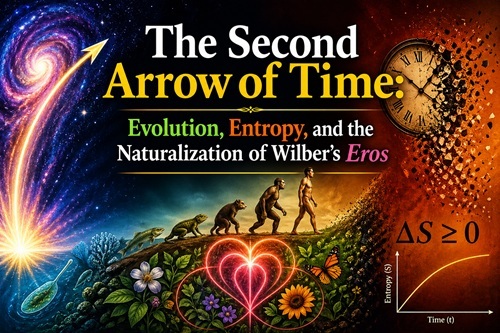 The essay "Time Brings Order to the Universe" (Nautilus, by science journalist Dan Falk) profiles the work of geoscientist Robert M. Hazen and astrobiologist Michael L. Wong (both at the Carnegie Institution for Science).[1] It argues that the second law of thermodynamics—often called the "arrow of time" pointing toward increasing entropy (disorder)—does not tell the full story of the cosmos. While entropy reliably explains decay, aging, cooling, and the universe's eventual heat death, it cannot account for the abundant emergence of order, complexity, and "functional information" we actually observe: acorns becoming oaks, minerals diversifying on planets, brains forming as "the most complex structure in the known cosmos," or cultural creations like music and recipes evolving through trial and selection. Main Thesis and Key Arguments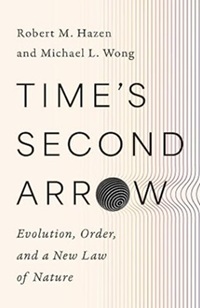
Hazen and Wong propose a complementary "second arrow of time" that drives systems toward greater complexity, patterning, diversity, and functional information over time. This is not a violation of the second law (local order can emerge in open systems that export entropy), but an additional natural tendency or "law" rooted in how evolving systems generate and select configurations that "do something useful" in a given environment. Functional information (building on earlier ideas from Jack Szostak and Hazen et al.): A quantifiable measure of the number of configurations in a system that achieve a functional goal. It increases through iterative processes of variation, selection for function, and "ratcheting up" complexity stage by stage. Examples include mineral evolution (from ~25 types in stellar dust to thousands on Earth via planetary processes) and even something mundane like perfecting apple pie through generations of recipe tweaks. The universe starts simple (post-Big Bang low entropy) but trends not just toward disorder but also toward richer informational and structural possibilities. Everyday experience—children growing, knowledge accumulating—contradicts a purely entropic worldview. Philosophically, they frame this as a mechanism, not teleology or purpose: "what we're describing is simply a mechanism. It's a selection mechanism that goes on without any direction, without any purpose, without any end point in mind." Functional information is contextual/environment-dependent, which challenges purely objective, context-free physical quantities, but scientists must describe nature "as it actually is." The essay draws from their 2023 PNAS paper and book Time's Second Arrow: Evolution, Order, and a New Law of Nature. It positions their idea as a starting point for a more complete picture of an "evolving cosmos," countering pessimistic views (e.g., Peter Atkins on the second law revealing "purposelessness" and "corruption"). Crucial Insight: The Evolution-Entropy ParadoxA key underlying tension in complexity science (implicit in Hazen and Wong's framework, and explicit in related thermodynamic discussions of dissipative structures) is the apparent paradox between evolution and entropy. Local evolution toward greater order, complexity, and functional information is only possible at the cost of producing even greater entropy in the larger environment or the universe as a whole. Living organisms, self-organizing chemical systems, and other evolving entities decrease their internal entropy (becoming more ordered and information-rich) by importing free energy (e.g., sunlight for plants, food for animals) and exporting waste heat and disordered byproducts. This “pays the entropy bill”: the decrease in entropy within the system is more than offset by a larger increase in entropy outside it, satisfying the second law. Prigogine's dissipative structures and modern non-equilibrium thermodynamics illustrate this clearly—order emerges far from equilibrium precisely because the system dissipates energy and increases total disorder. In Hazen and Wong's terms, the second arrow (selection for function driving functional information upward) operates within open systems that are simultaneously “burning” entropy via the first arrow. The two arrows are not opposing forces in conflict but complementary: the entropic arrow provides the thermodynamic driving force and gradient that makes the complexity-building arrow possible. Without relentless entropy production in the surroundings, the ratcheting of functional information could not persist. This resolves the old creationist-style objection that “evolution violates the second law” by showing evolution is thermodynamically subsidized by greater overall disorder. ReviewThe essay is well-written, optimistic, and effective at bridging abstract physics with everyday intuition. It counters overly pessimistic interpretations of entropy (e.g., Peter Atkins' view of the second law revealing only “purposelessness” and “corruption”) by highlighting how our lived experience—growth, learning, innovation—reveals a cosmos that builds as well as breaks down. Strengths include the broad applicability of “functional information” across scales and the emphasis on mechanism over mysticism. Limitations remain: the proposal is more descriptive and conceptual than a fully predictive, quantitative law with novel equations or crisp falsifiability criteria. It builds on existing ideas from non-equilibrium thermodynamics, assembly theory, and selection-based models without fully distinguishing itself in all critics' eyes. Nonetheless, it valuably reframes evolution as a cosmic phenomenon, not a biological exception. Relation to Ken Wilber's “Eros in the Kosmos”Ken Wilber's Sex, Ecology, Spirituality (and related works) posits an intrinsic "Eros" in the Kosmos—a self-transcending drive or "spirit-in-action" that propels evolution toward greater complexity, depth, consciousness, and eventual integration with Spirit. This Eros acts as a cosmic "tilt" or attractor, enabling holons (whole/parts) to transcend-and-include prior levels. Wilber draws on complexity sciences (chaos theory, self-organization, Prigogine's "order out of chaos") to support it but criticizes standard science (especially the second law taken in isolation) as insufficient or even "ridiculous" for explaining the observed rise of order; he often frames Eros as more than a metaphor—an ontological principle or quasi-force (sometimes likened to a "fifth force" of self-organization through self-transcendence) that natural selection or chance alone cannot fully account for. Without it, he suggests, the "why" of evolution's creative unfolding remains mysterious. The Nautilus essay echoes Wilber in key ways: • Both highlight the inadequacy of entropy-alone as a complete story and celebrate self-organization, increasing complexity, and an "arrow" toward order/information. • Both see this tendency operating across domains (physiosphere to biosphere to noosphere/culture). Wilber's "drive towards self-organization" and "self-transcending drive" parallel Hazen/Wong's ratcheting complexity via selection for functional information. However, the authors fully naturalize what Wilber attributes (at least partly) to Eros/Spirit. They insist on a blind, purposeless mechanism—contextual selection processes in open systems that build functional information incrementally—without direction, telos, consciousness, compassion, or spiritual self-realization. There is no "Spirit-in-action" pulling from the future or inherent drive of the Kosmos toward greater depth/Emptiness. It's physics/chemistry/geology/biology doing what they do, extended to a broader "law" of nature. This vindicates Wilber's empirical observation (complexity does robustly increase in important ways, contra simplistic entropy doom) and his appeal to complexity sciences, but it undercuts his stronger metaphysical claim. Science, in this framing, can explain the pattern naturalistically through selection, history, and informational ratcheting, without needing an extra ontological Eros. In short, Wilber is partially vindicated on the phenomenology (the universe winds up as well as down), but the essay supports critics who argue his Eros is an unnecessary reification of emergent, selection-driven processes already within a naturalistic worldview. It offers a more deflationary, mechanism-focused account that fits comfortably within an expanded scientific picture rather than requiring integral philosophy's spiritual overlay. This tension—between descriptive scientific patterns and interpretive "why" questions—remains fertile ground for dialogue between integral theory and frontier science.[2]
NOTES[1] Dan Falk, "Time Brings Order to the Universe, These scientists are proposing a new law of nature", Nautilus, April 7, 2026. [2] See also: "This New Theory Upends 150 Years of Established Science", Next Big Idea Club, 24 February, 2026.
Comment Form is loading comments...
|