|
TRANSLATE THIS ARTICLE
Integral World: Exploring Theories of Everything
An independent forum for a critical discussion of the integral philosophy of Ken Wilber
  Frank Visser, graduated as a psychologist of culture and religion, founded IntegralWorld in 1997. He worked as production manager for various publishing houses and as service manager for various internet companies and lives in Amsterdam. Books: Ken Wilber: Thought as Passion (SUNY, 2003), and The Corona Conspiracy: Combatting Disinformation about the Coronavirus (Kindle, 2020). Frank Visser, graduated as a psychologist of culture and religion, founded IntegralWorld in 1997. He worked as production manager for various publishing houses and as service manager for various internet companies and lives in Amsterdam. Books: Ken Wilber: Thought as Passion (SUNY, 2003), and The Corona Conspiracy: Combatting Disinformation about the Coronavirus (Kindle, 2020).
Check out my other conversations with ChatGPT The Rhetoric of DoubtDebunking David Berlinski's Attack on AtheismFrank Visser / ChatGPT
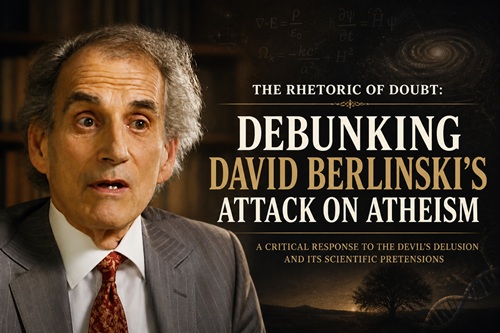 David Berlinski is a gifted polemicist. His writing is sharp, elegant, and rhetorically forceful. The quoted passage from The Devil's Delusion works less as a logical argument than as a performance of skepticism directed at atheism and science.[1] Through a rapid-fire series of questions followed by dismissive punchlines—“Not even close,” “Dead on”—Berlinski creates the impression that science has failed while religion remains intellectually viable. But the argument collapses under scrutiny. Most of the claims rely on misunderstandings of science, philosophy, or the burden of proof. The Burden of Proof ProblemBerlinski begins with the question: “Has anyone provided proof of God's inexistence?” This framing is already misleading. One generally cannot prove the nonexistence of vaguely defined supernatural entities. We cannot prove there are no invisible dragons, cosmic spirits, or transcendent intelligences outside space and time. The burden of proof lies with those making the positive claim. Atheism, at least in its most common philosophical form, is not the assertion that “God definitely does not exist.” It is the position that there is insufficient evidence to justify belief in God. Berlinski subtly shifts the standard, implying atheists must provide absolute metaphysical certainty before skepticism becomes rational. That is not how rational inquiry works. Science Does Not Need Complete Answers to Be ValidBerlinski repeatedly asks whether science has fully explained the origin of the universe, the emergence of life, or fine-tuning. Since science does not yet possess complete answers, he implies religion somehow gains credibility by default. This is the classic “God of the gaps” strategy. Throughout history, unexplained phenomena were routinely attributed to divine action: lightning, disease, planetary motion, biological complexity, and mental illness. Scientific progress replaced those supernatural explanations with natural mechanisms. Invoking God whenever knowledge is incomplete has an extraordinarily poor historical track record. Scientific uncertainty is not evidence for theology. In fact, science advances precisely because it acknowledges what it does not yet know. Berlinski treats incompleteness as failure, but provisional knowledge is one of science's greatest strengths. The Fine-Tuning Argument Is Not a Scientific DefeatBerlinski suggests that the apparent fine-tuning of the universe for life remains inexplicable to science. Fine-tuning is indeed a serious topic in cosmology and philosophy. But it is misleading to imply that science has no possible avenues of explanation. Several naturalistic approaches are actively explored: • Selection effects and the anthropic principle • Multiverse hypotheses • Inflationary cosmology • Deeper undiscovered physical laws • The possibility that life adapts to the universe rather than the universe being “designed” for life None of these are final answers. But “God designed the constants” is not an explanation either. It merely pushes the mystery back one step: why does God exist, and why would such a being require finely tuned physical laws? Theism does not eliminate complexity; it relocates it. Science Is Not Anti-Religious by DefinitionBerlinski claims that scientists are “willing to believe in anything so long as it is not religious thought.” This caricatures scientific methodology. Scientists accept ideas based on evidence, predictive success, internal coherence, and empirical testing. Religious explanations are not rejected because they are “religious,” but because they generally lack falsifiability and explanatory precision. A statement like “God intended it this way” can potentially explain everything—and therefore scientifically explains nothing. A hypothesis that accommodates every possible outcome has no predictive power. Science is not biased against religion. It is biased toward testable explanations. The Misuse of the Twentieth CenturyBerlinski also attacks secularism by pointing to the horrors of the twentieth century. This argument is historically superficial. The totalitarian regimes of the twentieth century were not simply products of secular rationalism. Nazism was saturated with mythic nationalism, racial mysticism, and quasi-religious symbolism. Stalinism functioned like a dogmatic ideological cult complete with sacred texts, heresy trials, and unquestionable authority. Meanwhile, secular liberal democracies produced enormous advances in medicine, science, education, human rights, and material well-being. The twentieth century demonstrated the dangers of authoritarianism and ideological absolutism—not the failure of secularism per se. Morality Does Not Require ReligionBerlinski claims rationalism has failed to explain morality. But moral philosophy has developed extensive secular frameworks for ethical reasoning: • Utilitarian ethics • Kantian deontology • Virtue ethics • Social contract theory • Evolutionary psychology and moral cognition None are perfect or universally accepted. But religion does not solve the problem either. Religious traditions disagree profoundly about morality, and divine command theories face the ancient Euthyphro dilemma: Is something good because God commands it, or does God command it because it is good? If morality depends solely on divine commands, morality becomes arbitrary. If God commands what is already good, then goodness exists independently of God. Either way, morality cannot simply be reduced to theology. Is Science an Orthodoxy?Berlinski's complaint about a scientific “orthodoxy” contains a partial truth exaggerated beyond recognition. Science is a human institution. It has professional pressures, dominant paradigms, and intellectual fashions. But unlike religious systems, science possesses built-in correction mechanisms: • Peer review • Replication • Predictive testing • Empirical falsification Scientific revolutions occur precisely because evidence can overturn orthodoxy. Relativity displaced Newtonian assumptions. Quantum mechanics shattered classical physics. Germ theory replaced miasma theory. No authority in science is beyond revision. That is fundamentally different from doctrinal systems grounded in revelation or sacred tradition. The Central Weakness: No Positive Case for GodThe most striking feature of Berlinski's passage is what it never does: provide evidence for God. This is the core weakness of much anti-atheist rhetoric. It catalogs unanswered questions and frustrations with secular culture, then treats those frustrations as indirect proof of religion. But exposing limitations in science does not validate supernatural explanations. If one wishes to argue for God, one must present positive reasons to believe in God—not merely point to unresolved scientific puzzles. Science as Disciplined IgnoranceIronically, Berlinski accuses science of arrogance while dismissing entire fields of inquiry in a few sarcastic lines. Science does not claim omniscience. It is a disciplined method for reducing ignorance incrementally through evidence and revision. Its strength lies not in possessing all answers, but in continually improving explanations while remaining open to correction. Religious explanations often end inquiry by declaring mysteries sacred. Science keeps asking questions. That difference matters. In the end, Berlinski offers not a devastating critique of atheism, but an eloquent expression of dissatisfaction with scientific naturalism and modern secular culture. His rhetoric is polished, but rhetorical force is not philosophical proof. NOTES[1] From the book promo page of The Devil's Delusion at David Berlinski's website:
Comment Form is loading comments...
|