|
TRANSLATE THIS ARTICLE
Integral World: Exploring Theories of Everything
An independent forum for a critical discussion of the integral philosophy of Ken Wilber
  Frank Visser, graduated as a psychologist of culture and religion, founded IntegralWorld in 1997. He worked as production manager for various publishing houses and as service manager for various internet companies and lives in Amsterdam. Books: Ken Wilber: Thought as Passion (SUNY, 2003), and The Corona Conspiracy: Combatting Disinformation about the Coronavirus (Kindle, 2020). Frank Visser, graduated as a psychologist of culture and religion, founded IntegralWorld in 1997. He worked as production manager for various publishing houses and as service manager for various internet companies and lives in Amsterdam. Books: Ken Wilber: Thought as Passion (SUNY, 2003), and The Corona Conspiracy: Combatting Disinformation about the Coronavirus (Kindle, 2020).
Check out my other conversations with ChatGPT Between Beast and ExceptionHumanity's Changing Place in the Animal KingdomFrank Visser / ChatGPT
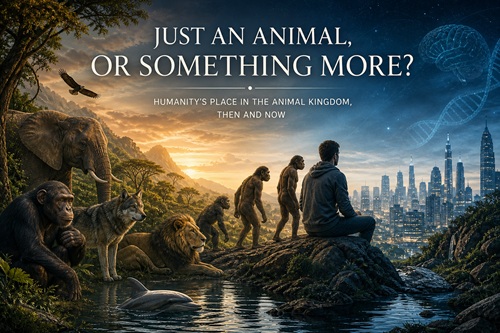 IntroductionAre humans “just animals,” or are we something fundamentally different? Few questions have shaped philosophy, religion, and science more deeply. Across history, humanity has repeatedly redrawn the boundary between itself and the rest of nature. Sometimes humans were seen as fallen beasts, sometimes as divine beings clothed in flesh, sometimes as rational machines, and today increasingly as one branch among many on the evolutionary tree of life. Yet the issue remains emotionally and philosophically charged. Humans build civilizations, create mathematics, compose symphonies, split the atom, invent gods, and contemplate their own mortality. No chimpanzee writes metaphysics or launches telescopes into space. At the same time, biology has steadily erased older assumptions about human uniqueness. We share genes, anatomy, emotions, and evolutionary ancestry with every other living organism. The tension between continuity and uniqueness has never disappeared. It merely changes form. The Ancient World: Humans Between Nature and the GodsIn many ancient cultures, humans occupied an ambiguous middle position between animals and divinity. Greek philosophers especially struggled with defining what made humans distinctive. Aristotle famously called man the “rational animal.” This definition preserved continuity with the animal kingdom while assigning humans a special faculty: reason. Animals possessed sensation and appetite, but humans alone possessed logos—the capacity for abstract thought, deliberation, and political life. Other ancient traditions emphasized different distinctions. Stoics argued that humans uniquely participated in cosmic reason. In the Hebrew tradition, humanity was created “in the image of God,” granting humans spiritual dignity and dominion over animals. This did not deny human bodily kinship with animals, but it elevated humans metaphysically above them. Ancient societies depended heavily on animals for labor, food, sacrifice, and symbolism. Animals were both familiar and mysterious. Myths often blurred species boundaries through hybrid creatures, shape-shifting gods, or animal deities. The line between human and animal was not always absolute. Still, most ancient thinkers assumed that humans occupied a privileged rung in the cosmic hierarchy. Medieval Christianity: The Great Chain of BeingDuring the medieval period, Christian theology reinforced human exceptionalism. The dominant worldview became the “Great Chain of Being,” a hierarchical cosmos extending from matter to plants, animals, humans, angels, and God. Humans were considered unique because they possessed immortal souls. Animals were alive and sentient, but they lacked rationality and spiritual destiny. Human beings alone were thought capable of salvation, moral responsibility, and conscious relation to God. This framework strongly separated humans from animals despite obvious biological similarities. Human superiority was theological rather than anatomical. Yet medieval thinkers were not uniformly dismissive of animals. Saint Francis of Assisi famously treated animals as spiritual companions within creation. Nevertheless, the overall intellectual structure remained hierarchical: animals existed below humanity in both moral and cosmic status. Descartes and the Mechanization of AnimalsThe Scientific Revolution transformed perceptions of nature. René Descartes introduced one of the sharpest separations ever proposed between humans and animals. Descartes argued that animals were essentially biological machines—complex automata lacking consciousness or genuine thought. Humans alone possessed minds or souls capable of self-awareness and reason. This mechanistic view helped justify vivisection and scientific experimentation on animals. If animals lacked true consciousness, their suffering could be minimized philosophically. Ironically, modern science would later undermine Descartes' position. Increasing evidence for animal cognition, emotion, communication, and even forms of self-awareness has made the Cartesian model largely untenable. Still, Descartes intensified a trend that modernity would inherit: humans as uniquely conscious subjects confronting a largely mechanistic natural world. Darwin and the Collapse of Human ExceptionalismNo figure altered humanity's self-understanding more dramatically than Charles Darwin. Before Darwin, many assumed humans occupied a separate category of creation. Darwin's theory of evolution by natural selection demolished this divide. Humans were no longer specially created beings standing outside nature. They were evolved primates sharing common ancestry with all life. Darwin's most radical contribution was not merely biological evolution itself, but psychological continuity between humans and animals. In The Descent of Man, he argued that differences between human and animal minds were differences of degree, not kind. Emotions, social instincts, tool use, communication, even morality—all had evolutionary precursors in animals. This was deeply destabilizing culturally. Humanity was no longer the center or goal of creation. Humans became one twig on a vast evolutionary bush. Religious resistance to Darwin often reflected more than scientific disagreement. The theory threatened long-standing assumptions about human uniqueness, dignity, and cosmic significance. The Twentieth Century: From Instinct to CultureTwentieth-century thought oscillated between reducing humanity to biology and emphasizing human uniqueness through culture. Behaviorists and sociobiologists stressed continuity between human and animal behavior. Human actions increasingly appeared rooted in evolutionary drives, instincts, and adaptive strategies. At the same time, philosophers and anthropologists emphasized features seemingly unparalleled in animals: • Symbolic language • Cumulative culture • Large-scale cooperation • Moral systems • Science and technology • Historical consciousness • Art and religion Thinkers such as Ernst Cassirer described humans as “symbolic animals.” Humans do not merely react to environments; they inhabit worlds of meaning. Meanwhile, ethology increasingly complicated simplistic human superiority. Researchers such as Jane Goodall revealed striking continuities between humans and great apes: emotional bonds, tool use, warfare, deception, and social politics. The old image of animals as instinct-driven automatons steadily eroded. Modern Evolutionary Biology: Continuity EverywhereContemporary biology overwhelmingly supports humanity's continuity with the animal kingdom. Humans share roughly 98-99% of their DNA with chimpanzees. Human anatomy, embryology, neurobiology, and genetics all point unmistakably toward common ancestry. Increasingly, traits once considered uniquely human have been found in partial form elsewhere: • Tool use in crows and apes • Empathy in elephants • Problem-solving in octopuses • Communication systems in whales • Self-recognition in dolphins and magpies • Social learning across many species The trend has been consistent: human uniqueness keeps shrinking under scientific scrutiny. And yet, something unusual clearly happened in human evolution. No other species has produced global civilization, written language, particle physics, constitutional law, digital technology, or planetary environmental transformation. Humans dominate the biosphere to an extent unmatched by any other organism in Earth's history. The debate today is therefore less about whether humans are animals—they unquestionably are—and more about what kind of animal humans are. The Case for Human ExceptionalismDespite evolutionary continuity, many philosophers and scientists still defend some form of human exceptionalism. Several traits remain extraordinary in combination and scale: LanguageHuman language possesses recursive syntax and open-ended symbolic abstraction far beyond known animal communication systems. CultureHuman knowledge accumulates across generations in ways that vastly exceed animal social learning. Civilization acts as a second evolutionary system: cultural evolution. Self-ConsciousnessHumans reflect on themselves abstractly, construct identities, imagine futures, and contemplate death. MoralityWhile proto-moral behaviors exist in social animals, humans develop explicit ethical systems, laws, and universal principles. TechnologyHumans reshape entire ecosystems intentionally through cumulative technological innovation. Existential AwarenessHumans uniquely ask metaphysical questions: • Why are we here? • What is consciousness? • What is truth? • What happens after death? Some argue these differences are merely quantitative. Others see them as qualitative thresholds that fundamentally transform the human condition. The Danger of Both ExtremesTwo opposite errors often distort the debate. One is radical anthropocentrism: the belief that humans stand wholly outside nature, superior to all life by divine or metaphysical decree. Historically, this has often justified exploitation of animals and ecosystems. The opposite error is reductive naturalism: the claim that humans are “nothing but animals,” as though Shakespeare, quantum mechanics, ethics, and religion differ from chimpanzee behavior only trivially. Both views oversimplify reality. Humans are undeniably animals biologically. We evolved, reproduce, compete, cooperate, age, and die like other organisms. Our brains are products of evolution, not supernatural insertions into nature. But humans are also culturally and cognitively exceptional in ways that are historically unprecedented. Evolution produced in humanity a species capable of reflecting on evolution itself. That fact alone is remarkable. ConclusionThe historical movement has been clear: humanity has gradually descended from heaven into nature. Ancient and medieval cultures placed humans near the divine; modern science situates them firmly within the animal kingdom. Yet the story did not end in reduction. Instead, a more complex picture emerged. Humans are animals shaped by evolutionary history, sharing deep continuity with all life. But humans are also animals capable of symbolic thought, civilization, science, morality, and self-transcendence on a scale unmatched elsewhere in nature. The real challenge is not choosing between “just animals” and “special creatures.” It is understanding how both are true simultaneously. Humanity is not outside nature. But neither is humanity merely another animal in the ordinary sense. We are nature becoming conscious of itself.
Comment Form is loading comments...
|