|
TRANSLATE THIS ARTICLE
Integral World: Exploring Theories of Everything
An independent forum for a critical discussion of the integral philosophy of Ken Wilber
  Frank Visser, graduated as a psychologist of culture and religion, founded IntegralWorld in 1997. He worked as production manager for various publishing houses and as service manager for various internet companies and lives in Amsterdam. Books: Ken Wilber: Thought as Passion (SUNY, 2003), and The Corona Conspiracy: Combatting Disinformation about the Coronavirus (Kindle, 2020). Frank Visser, graduated as a psychologist of culture and religion, founded IntegralWorld in 1997. He worked as production manager for various publishing houses and as service manager for various internet companies and lives in Amsterdam. Books: Ken Wilber: Thought as Passion (SUNY, 2003), and The Corona Conspiracy: Combatting Disinformation about the Coronavirus (Kindle, 2020).
Check out my other conversations with ChatGPT Human Nature as a SpiralA Review of Clare W. Graves' 'Human Nature Prepares for a Momentous Leap'Frank Visser / ChatGPT
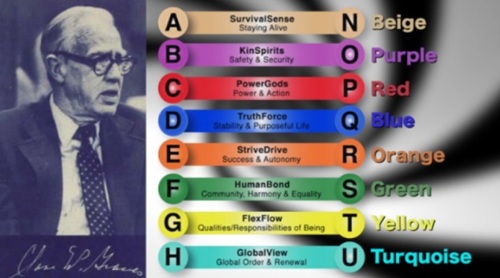 Introduction: A Psychology of Large-Scale ChangeClare W. Graves's essay “Human Nature Prepares for a Momentous Leap” (1974) is one of the earliest coherent statements of what later became Spiral Dynamics. It is not a conventional academic paper with tight operational definitions and controlled variables, but rather a synthetic theory built from longitudinal clinical observation of adult personality systems. The central ambition is ambitious in scope: to explain not just personality differences, but the deep structural logic behind shifts in human value systems across individuals, organizations, and entire societies. Core Thesis: Human Nature as an Adaptive SystemGraves' basic claim is that human beings do not possess a fixed psychological structure. Instead, they operate as adaptive systems that reorganize themselves in response to life conditions. Each “level of existence” is a coherent configuration of cognition, motivation, emotion, and social behavior. These configurations emerge when existing ways of solving existential problems break down. Importantly, Graves treats this as systemic adaptation rather than moral improvement. The implication is subtle but significant: development is not about becoming “better” in any absolute sense, but about becoming functionally adequate to increasingly complex realities. The Spiral Logic: Alternating Modes of ExistenceA key structural idea in the essay is the alternation between two broad types of orientation: First, there are externally focused systems centered on survival, control, order, and material mastery. These dominate when environments are unstable or existentially demanding. Second, there are internally focused systems oriented toward meaning, belonging, integration, and experiential depth. These become prominent when survival pressures are stabilized and psychological space opens up for reflection. Graves argues that development proceeds through oscillation between these poles. Each new configuration solves problems the previous one could not handle, but simultaneously generates new forms of tension that eventually require another shift. The “Subsistence Levels”: Survival-Based OrganizationThe early stages of Graves' model (often labeled A-N through F-S in this essay) describe modes of psychological organization rooted in survival imperatives. At these levels, behavior is shaped by immediacy, power dynamics, tribal cohesion, rule enforcement, economic mastery, and interpersonal bonding. These are not portrayed as primitive in a dismissive sense, but as structurally appropriate responses to specific environmental conditions. A crucial point in Graves' formulation is that each level is internally rational. What appears dysfunctional from a higher-order perspective is often perfectly adaptive within its own existential context. The “Being Levels”: Toward Systemic AwarenessThe later sections of the essay introduce what Graves calls the “being levels” (often associated with G-T and H-U). Here the tone shifts from descriptive psychology toward broader civilizational speculation. At these levels, individuals are described as capable of systemic thinking: integrating multiple value systems, perceiving ecological interdependence, and prioritizing the stability of the whole over local optimization. Graves also hints at a further mode characterized by open-ended experiential awareness, where fixed ideological structures loosen and cognition becomes more fluid and context-sensitive. This is where the model begins to resemble a theory of consciousness evolution rather than a purely psychological taxonomy. Management and Society: Value Systems in InstitutionsOne of the most practically oriented sections of the essay concerns organizational life. Graves argues that managerial failure often arises from misalignment between institutional structures and the value systems of individuals operating within them. Different psychological levels require different forms of governance, motivation, and authority structure. A system optimized for order, for example, may fail when applied to actors operating from a more relational or systemic orientation. This leads to a relativized view of leadership: there is no universally optimal management style, only contextually appropriate ones. The Question of Direction: Evolution or Interpretation?Although Graves occasionally resists explicit teleology, the essay carries a strong directional implication: human systems appear to move toward increasing integration, complexity, and contextual awareness. This raises a persistent interpretive tension. The model is presented as empirically grounded, but it also reads as a narrative of civilizational ascent. Whether this is a descriptive pattern or a subtle value judgment remains one of the central ambiguities in the work. Strengths and Limitations of the ModelThe strength of Graves' approach lies in its emphasis on discontinuous transformation and systemic adaptation. It captures something important about how value systems reorganize under pressure rather than gradually evolve. It also anticipates later complexity theory in its view of human behavior as emergent from interacting constraints rather than linear psychological accumulation. However, the model is underdetermined in key respects. The levels are richly described but not sharply operationalized, making empirical testing difficult. Boundaries between stages often remain interpretive rather than measurable. This leaves the theory vulnerable to reification in later interpretations, where fluid adaptive patterns become rigid stage hierarchies. Conclusion: A Theory Between Psychology and Civilizational ForecastingGraves' essay sits in an unusual intellectual space. It is simultaneously empirical generalization, systems theory, and speculative anthropology. Its enduring appeal lies in its ability to connect individual psychology with large-scale social transformation. Its limitation lies in the temptation to turn a descriptive model of adaptive complexity into a simplified ladder of progress. Read carefully, however, the original text is more nuanced: development is not guaranteed ascent, but contingent reorganization under pressure. In that sense, the “momentous leap” is less a destination than a recurring possibility within the ongoing dynamics of human adaptation. Appendix: Graves and Maslow—Two Developmental Logics of Human MotivationA useful way to clarify Graves' contribution is to compare it with Abraham Maslow, since Maslow provides the most familiar precursor to stage-based models of human motivation. Superficially, the two look similar: both propose layered structures of human needs and both imply some form of upward developmental movement. But structurally, they are built on quite different assumptions. 1. Structural Unit: Needs vs. SystemsMaslow's model is fundamentally a hierarchy of needs. The basic unit is the individual need: physiological requirements, safety, belonging, esteem, and self-actualization. These needs are arranged in a quasi-linear order of priority, where lower needs generally dominate until sufficiently satisfied. Graves, by contrast, does not start with needs but with adaptive systems. His basic unit is not a need but a coherent psycho-biological configuration that includes cognition, emotion, values, and social behavior as an integrated whole. What Maslow treats as “motivation,” Graves treats as a full operating system for reality management. This difference is crucial: Maslow is primarily motivational psychology; Graves is closer to systems theory applied to personality and culture. 2. Directionality: Hierarchy vs. Oscillating SpiralMaslow's model is explicitly hierarchical and cumulative. Higher needs become salient once lower needs are sufficiently satisfied, producing a relatively stable upward trajectory toward self-actualization and, in later revisions, self-transcendence. Graves rejects this clean linearity. His model is explicitly oscillatory: development moves through alternating modes of external focus (survival, control, structure) and internal focus (meaning, belonging, integration). Each new system is not simply “higher,” but different in functional orientation. Where Maslow suggests a staircase, Graves proposes a spiral: recurrence with transformation rather than simple ascent. 3. Trigger Mechanism: Satisfaction vs. BreakdownMaslow's transitions are driven largely by satisfaction thresholds. When a need is adequately met, attention shifts upward to the next level. The system is fundamentally homeostatic: fulfillment enables progression. Graves' transitions are driven by system breakdown. A value system does not evolve because it is satisfied, but because it becomes inadequate to handle emerging life conditions. Development is therefore crisis-driven rather than gratification-driven. This makes Graves' model more dynamic and historically sensitive, whereas Maslow's is more individual-psychological and equilibrium-oriented. 4. Scope: Individual Psyche vs. Bio-Psycho-Social SystemsMaslow's framework is primarily an account of individual motivation. Even when extended to “self-actualizing” persons or peak experiences, the reference point remains the individual organism. Graves explicitly expands the unit of analysis to bio-psycho-social systems. A “level” is not just a personality trait cluster but a full cultural-cognitive regime that can characterize individuals, organizations, and entire societies simultaneously. This allows Graves to move into cultural evolution, organizational theory, and civilizational analysis in a way Maslow never systematically attempted. 5. Teleology: Self-Actualization vs. Open-Ended AdaptationMaslow's later work introduces a clear teleological endpoint: self-actualization and eventually self-transcendence represent the highest realizable states of human development. Although he sometimes qualifies this, the directional implication remains strong. Graves is more ambiguous. While later interpretations of his work (especially in Spiral Dynamics) often reintroduce a hierarchy of “higher” stages, Graves himself frames development as open-ended adaptation. There is no guaranteed endpoint, only successive equilibria with no final stable state. In this sense, Maslow is closer to humanistic psychology, while Graves leans toward evolutionary systems theory. 6. Convergence: Where the Two Models OverlapDespite these differences, there are important points of convergence. Both models: Reject static views of human nature Assume layered complexity in motivation and cognition Imply that context shapes psychological organization Recognize higher-order integration as a real developmental possibility It is not accidental that Graves' early thinking was influenced by Maslow, even if he later diverged methodologically. Conclusion: Two Architectures of DevelopmentMaslow offers a structured psychology of needs and fulfillment. Graves offers a dynamic systems theory of adaptive value regimes under pressure. One is fundamentally equilibrium-based, the other far-from-equilibrium. If Maslow describes how humans seek satisfaction within a structured motivational ladder, Graves describes how entire human systems reorganize when that ladder itself becomes unstable.
Comment Form is loading comments...
|