|
TRANSLATE THIS ARTICLE
Integral World: Exploring Theories of Everything
An independent forum for a critical discussion of the integral philosophy of Ken Wilber
  Frank Visser, graduated as a psychologist of culture and religion, founded IntegralWorld in 1997. He worked as production manager for various publishing houses and as service manager for various internet companies and lives in Amsterdam. Books: Ken Wilber: Thought as Passion (SUNY, 2003), and The Corona Conspiracy: Combatting Disinformation about the Coronavirus (Kindle, 2020). Frank Visser, graduated as a psychologist of culture and religion, founded IntegralWorld in 1997. He worked as production manager for various publishing houses and as service manager for various internet companies and lives in Amsterdam. Books: Ken Wilber: Thought as Passion (SUNY, 2003), and The Corona Conspiracy: Combatting Disinformation about the Coronavirus (Kindle, 2020).
Check out my other conversations with ChatGPT Why Facebook Comments Rarely Address the Actual TopicSocial Media as Reaction Culture Rather Than Discussion CultureFrank Visser / ChatGPT
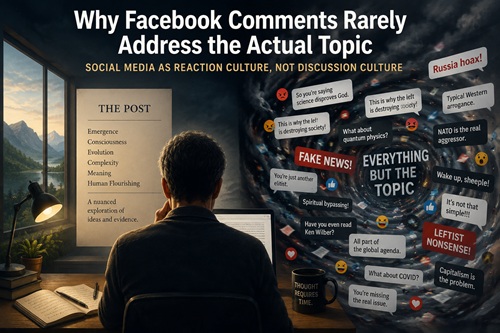
Introduction: The Strange Fate of Online DiscussionAnyone who posts serious content on social media eventually notices a peculiar phenomenon: the comments often have little to do with the actual topic of the post. A carefully argued essay about geopolitics turns into a shouting match about ideology. A nuanced reflection on spirituality becomes a debate about science versus religion. A post on emergence suddenly spirals into COVID conspiracies or complaints about mainstream media. This is not merely anecdotal frustration. It reflects a structural feature of contemporary online communication. Platforms such as Meta Platforms's Facebook are not optimized for sustained intellectual engagement. They are optimized for reaction, visibility, emotional stimulation, and identity performance. As a result, the comment section often functions less as a forum for discussion than as a stage for projection. The Attention Economy Rewards Reaction, Not ComprehensionSocial media platforms operate within what is commonly called the “attention economy.” Their economic model depends on maximizing engagement: clicks, comments, shares, outrage, emotional activation, and time spent on the platform. Careful reading does not generate rapid engagement. Emotional reaction does. Most users therefore do not read posts analytically. They scan for cues: • emotionally charged words, • ideological markers, • recognizable names, • cultural triggers, • or statements confirming prior beliefs. A long essay may be reduced in the reader's mind to a single keyword: • “Russia” • “Trump” • “evolution” • “consciousness” • “capitalism” • “spirituality” The response then addresses the triggered association rather than the argument itself. The commenter is often reacting not to what was written, but to what the topic symbolizes within their psychological landscape. Facebook Encourages Speed Over ReflectionThe architecture of Facebook actively discourages careful thought. Posts appear in a rapidly scrolling feed surrounded by distractions: • advertisements, • notifications, • memes, • family updates, • political outrage, • and algorithmically amplified emotional content. Users consume information in fragments and respond instantly. In traditional intellectual culture, one reads first and replies afterward. On social media, the order is often reversed psychologically: people feel first and think later. This produces what might be called “reflex commenting”: • reacting before understanding, • interpreting before reading, • attacking before clarifying. The result is conversational derailment almost by design. Comment Sections as Identity PerformanceMany online comments are not attempts at dialogue at all. They are performances of identity. People comment in order to: • signal intelligence, • display moral virtue, • demonstrate tribal loyalty, • gain attention, • or reinforce group belonging. The original post merely provides the stage. This explains why commenters frequently redirect discussions toward familiar ideological scripts. A post about scientific emergence becomes a battlefield between materialism and mysticism. A post about international politics becomes a referendum on America, NATO, Russia, or capitalism regardless of the original focus. The content matters less than the opportunity for symbolic positioning. Readers Respond to the Persona, Not the ArgumentWriters who have cultivated a recognizable public identity encounter an additional complication: audiences stop responding to individual arguments and begin responding to the perceived persona behind them. This is particularly true for controversial intellectual figures or critics. A long-time critic of Ken Wilber, for example, may no longer be read neutrally by integral audiences. Readers approach the post carrying pre-existing assumptions: • “the skeptic,” • “the reductionist,” • “the anti-mystic,” • “the critic of spirituality.” Once such framing occurs, many commenters respond defensively before they have fully processed the actual content. The discussion becomes personalized and archetypal rather than analytical. Complex Topics Trigger SimplificationSubjects such as: • spirituality, • evolution, • consciousness, • geopolitics, • COVID, • religion, • and ideology are deeply entangled with identity and worldview. Most people lack the time, training, or inclination to engage these subjects with nuance. Complexity therefore gets collapsed into simplistic binaries: • science vs spirituality, • left vs right, • realism vs idealism, • freedom vs control, • mainstream vs alternative. A sophisticated argument about emergence may thus generate comments that never engage emergence itself. Instead, readers translate the discussion into familiar ideological templates. The richer the original analysis, the greater the temptation to simplify it. The Asymmetry of EffortAnother overlooked factor is the massive asymmetry between writing and commenting. An author may spend: • hours researching, • days formulating ideas, • years developing expertise. The average commenter invests perhaps fifteen seconds. This imbalance creates structural frustration. The intellectual density of the original post cannot realistically survive the rapid-fire mechanics of social media interaction. Long-form thinking collides with short-form reaction. The result is often a sense of trivialization: serious analysis gets absorbed into a medium fundamentally hostile to sustained attention. The Drift Effect in Comment ThreadsEven when the initial comments are relevant, discussions often drift rapidly away from the original topic. This happens because comment sections develop their own internal momentum. Once several commenters begin discussing a side issue, subsequent participants follow the emerging conversational current rather than returning to the original subject. Over time, the thread becomes socially self-organizing: • the most emotionally engaging tangent dominates, • the loudest participants shape direction, • and the original post recedes into the background. The thread effectively detaches itself from its source. Social Media Is Not Essay CultureThere is also a deeper cultural mismatch involved. Long-form intellectual writing belongs to what might be called “essay culture”: • reflective reading, • conceptual precision, • delayed judgment, • and sustained argumentation. Facebook belongs to “reaction culture”: • immediacy, • emotional visibility, • fragmentation, • and performative engagement. These are fundamentally different communication ecosystems. A serious essay posted on Facebook enters an environment optimized for distraction and emotional velocity. Under such conditions, derailment is not an exception. It is the default outcome. Conclusion: The Medium Shapes the MindThe failure of comment sections to remain on topic is not primarily a moral failure of individuals. It reflects the deeper logic of the medium itself. Social media platforms encourage: • speed over reflection, • reaction over comprehension, • identity over inquiry, • and performance over dialogue. For writers attempting to discuss complex subjects seriously, this creates a persistent tension. One brings nuanced thought into a communication environment designed to fragment nuance into emotionally consumable fragments. The result is the modern comment section: a place where almost everything is discussed except the actual topic.
Comment Form is loading comments...
|