|
TRANSLATE THIS ARTICLE
Integral World: Exploring Theories of Everything
An independent forum for a critical discussion of the integral philosophy of Ken Wilber
  Frank Visser, graduated as a psychologist of culture and religion, founded IntegralWorld in 1997. He worked as production manager for various publishing houses and as service manager for various internet companies and lives in Amsterdam. Books: Ken Wilber: Thought as Passion (SUNY, 2003), and The Corona Conspiracy: Combatting Disinformation about the Coronavirus (Kindle, 2020). Frank Visser, graduated as a psychologist of culture and religion, founded IntegralWorld in 1997. He worked as production manager for various publishing houses and as service manager for various internet companies and lives in Amsterdam. Books: Ken Wilber: Thought as Passion (SUNY, 2003), and The Corona Conspiracy: Combatting Disinformation about the Coronavirus (Kindle, 2020).
Check out my other conversations with ChatGPT Back to Square One?The Stalemate in the Philosophy of MindFrank Visser / ChatGPT
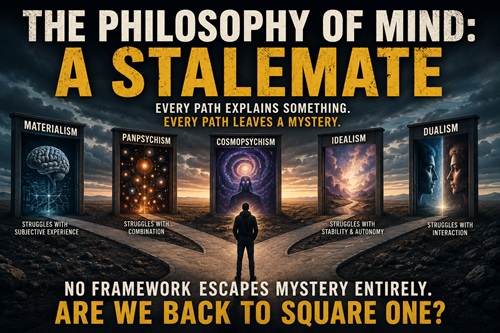 For centuries, philosophers, scientists, theologians, and mystics have attempted to solve what may be the deepest problem of all: how mind relates to reality. Is consciousness produced by matter? Is matter produced by consciousness? Are both fundamental? Or are they aspects of something deeper still? Despite immense conceptual sophistication and scientific progress, the philosophy of mind has arrived at a peculiar impasse. Every major ontology explains something well—but only at the cost of leaving something else unexplained. Each framework solves one mystery by generating another. The result is not victory for one school over the others, but a growing recognition that consciousness may represent a permanent explanatory horizon. We may, in fact, be back at Square One. Materialism: Matter Explains Everything—Except ExperienceMaterialism remains the dominant ontology in science. Its core claim is straightforward: reality consists fundamentally of physical processes, and consciousness emerges from sufficiently complex arrangements of matter, especially brains. Materialism has enormous strengths. It integrates seamlessly with physics, biology, neuroscience, and evolutionary theory. It explains why damage to the brain affects consciousness, why anesthesia works, and why mental states correlate with neural states. But it runs into the notorious “Hard Problem of Consciousness,” formulated most famously by David Chalmers. Even if neuroscience completely mapped every neural process, a conceptual gap seems to remain: why should physical activity produce subjective experience at all? Why should electrochemical activity feel like anything from the inside? A complete physical description of the brain appears to describe structure, function, and behavior—but not felt experience itself. One can explain visual processing mechanistically without explaining why redness is experienced as red. Materialism excels at third-person explanation while struggling with first-person existence. Some materialists deny the problem altogether. Others reduce consciousness to information processing or cognitive access. Still others embrace illusionism, arguing that consciousness as ordinarily conceived does not actually exist. But many observers feel these moves explain consciousness away rather than explain it. Panpsychism: Consciousness Everywhere—But How Does It Combine?In response to the failures of materialism, panpsychism has enjoyed a remarkable revival. Philosophers such as Galen Strawson and Philip Goff argue that consciousness must be fundamental rather than emergent. Instead of consciousness magically appearing at high levels of complexity, panpsychism proposes that rudimentary experientiality exists throughout nature. Even elementary particles may possess unimaginably simple proto-experiential properties. This elegantly avoids the Hard Problem. Consciousness does not emerge from non-conscious matter because matter was never wholly non-conscious to begin with. But panpsychism immediately encounters the Combination Problem. How do countless micro-experiences combine into a unified human consciousness? If electrons possess tiny experiential aspects, how do billions of them generate the single coherent perspective you experience right now? Why does consciousness unify at the level of organisms rather than remaining fragmented into trillions of micro-subjectivities? No convincing mechanism has yet been provided. Panpsychism therefore relocates the mystery rather than dissolving it. Materialism struggles to get consciousness into the universe at all; panpsychism struggles to explain how consciousnesses merge. Cosmopsychism: One Cosmic Mind—But How Does It Fragment?Cosmopsychism attempts to solve the Combination Problem by reversing the direction entirely. Instead of building minds upward from particles, cosmopsychism starts with a single universal consciousness. Individual minds are then viewed as partial expressions, dissociations, or localizations of a larger cosmic subject. This idea resonates strongly with mystical traditions and with certain forms of absolute idealism. Philosophers like Bernardo Kastrup have defended modern versions of this view. Cosmopsychism elegantly avoids the problem of combining micro-minds because there is only one ultimate mind to begin with. But it immediately encounters the Decomposition Problem. How does one cosmic consciousness fragment into billions of apparently separate conscious beings? Why do individual minds possess private perspectives, memory boundaries, and psychological autonomy? Why are you not directly aware of everyone else's thoughts? Why does the cosmic subject appear partitioned into isolated centers of experience tied so precisely to brains? The explanatory burden simply shifts direction. Panpsychism cannot explain mental fusion. Cosmopsychism cannot explain mental division. Idealism: Mind Creates Reality—But Why Is the World So Stable?Idealism proposes that consciousness is primary and that the physical world is derivative or experiential in nature. Reality is fundamentally mental. This framework has ancient roots in both Western and Eastern philosophy and has seen renewed interest through contemporary analytic idealism. Idealism neatly avoids the Hard Problem because matter itself becomes a manifestation within consciousness. There is no need to explain how mind emerges from matter if matter already exists within mind. Yet idealism faces a stubborn problem of its own: the remarkable stability, autonomy, and mathematical regularity of the physical world. Why does the world behave so independently of our wishes? Why do physical laws remain stable regardless of belief? Why did galaxies evolve for billions of years before humans appeared? Why does nature resist us so consistently? Idealists often answer by positing deeper transpersonal structures of mind or collective mental regularities. But critics argue that this begins to reintroduce objective quasi-physical structures under another name. The physical world stubbornly behaves as though it possesses its own autonomous integrity. Idealism explains subjectivity beautifully but risks under-explaining objectivity. Dualism: Two Realms—But How Do They Interact?Dualism, classically associated with René Descartes, treats mind and matter as fundamentally distinct substances or properties. This has the intuitive advantage of respecting the apparent irreducibility of conscious experience while also acknowledging the physical world. But dualism immediately faces the Interaction Problem. How can two radically different ontological domains causally influence one another? How does an immaterial thought move a physical arm? How does physical damage to the brain alter subjective experience? Modern neuroscience intensifies this problem because mental and neural events appear deeply intertwined at every level. Dualism preserves both mind and matter, but at the cost of explaining how the two communicate across an ontological divide. The Recurring Pattern: Mystery MigrationWhat is striking is that none of these ontologies collapses under trivial objections. Each captures something important. • Materialism captures the dependence of mind on brain. • Panpsychism captures the apparent irreducibility of experience. • Cosmopsychism captures unity. • Idealism captures the primacy of subjectivity. • Dualism captures the apparent distinctness between mind and matter. Yet every framework generates a compensatory mystery. The philosophy of mind increasingly resembles a conservation law of perplexity: eliminate one impossibility and another appears elsewhere. The mystery migrates but never disappears. Science Has Advanced—But the Core Puzzle RemainsNeuroscience has made astonishing progress in mapping correlations between brain states and conscious states. Cognitive science has explained perception, memory, attention, and decision-making in increasingly mechanistic terms. But correlation is not identity. We can now describe the neural correlates of pain with exquisite precision while still not understanding why pain feels like pain. The ancient explanatory gap persists beneath the technical sophistication. Indeed, some philosophers suspect the problem may be structurally insoluble—not because consciousness is supernatural, but because human cognition itself may be evolutionarily limited. Just as a dog cannot understand quantum mechanics, perhaps human minds are constitutionally incapable of fully comprehending consciousness. This position—sometimes called “mysterianism”—at least has the virtue of intellectual humility. Back to Square One?Does this mean all theories fail equally? Not necessarily. Some frameworks may still prove more coherent, parsimonious, or scientifically fruitful than others. But triumphalist claims increasingly look premature. The dream that one elegant ontology would finally dissolve all mystery has repeatedly collapsed. Every metaphysical system eventually encounters its own explanatory event horizon. Perhaps consciousness is not merely another scientific problem awaiting solution, like electricity or genetics. Perhaps it exposes a deeper limitation in conceptual thought itself. Or perhaps the very demand for total explanation is misguided. After centuries of debate, the philosophy of mind has not converged toward consensus but toward a recognition of mutually irreducible difficulties. The battlefield remains littered with elegant but incomplete systems. • Materialism cannot fully explain experience. • Panpsychism cannot fully explain unity. • Cosmopsychism cannot fully explain multiplicity. • Idealism cannot fully explain objectivity. • Dualism cannot fully explain interaction. Every road leads to mystery. And so, after all the arguments, distinctions, refinements, and revolutions, philosophy may find itself standing where it began: facing consciousness itself with awe, confusion, and unfinished theories. Appendix: Doesn't Science Support Naturalism at Every Turn?At first glance, it certainly seems so. Modern science has explained an astonishing range of phenomena once attributed to spirits, gods, souls, or occult forces. Lightning became electromagnetism. Disease became microbiology. Life became biochemistry and evolution. Mental impairment became neurology. Again and again, supernatural explanations retreated as natural explanations advanced. This historical pattern strongly favors naturalism. Moreover, neuroscience continually reinforces the dependence of consciousness on the brain. Alter the brain chemically, and consciousness changes. Damage the cortex, and personality shifts. Suppress neural activity, and awareness disappears. Split hemispheres, and cognition fragments. These are not minor observations. They form a massive cumulative case that mind is deeply tied to physical processes. So why do philosophers of mind still debate the issue? Because correlation and dependence are not necessarily identical to ontological reduction. A radio depends on circuitry to produce music, but the circuitry itself is not the music. Likewise, critics argue that demonstrating brain-consciousness dependence does not yet explain why physical processes should generate subjective experience in the first place. The central issue is not whether brains matter—they obviously do—but whether consciousness can be exhaustively explained in third-person physical terms. This is where the debate becomes more subtle. Science excels at describing structure, function, behavior, and causal relations. Physics describes mathematical relations between entities. Biology describes adaptive systems. Neuroscience describes information processing and neural dynamics. But subjective experience has a first-person character that seems resistant to purely structural description. A complete physical account of color vision may explain wavelength discrimination, retinal processing, cortical activation, and behavioral responses. Yet critics argue that something still remains unaccounted for: why redness feels like anything at all. This is the point where some philosophers conclude that consciousness must be fundamental in some sense rather than derivative. Importantly, this does not automatically imply mysticism or anti-science. Many non-materialist philosophers remain fully committed to scientific realism and empirical rigor. Their disagreement concerns metaphysical interpretation, not scientific practice. In fact, science itself underdetermines metaphysics more often than people realize. The same empirical facts can frequently support multiple ontological interpretations. Quantum mechanics is a famous example. The equations work extraordinarily well, yet physicists still disagree about what the equations mean. Copenhagen, Many Worlds, pilot-wave theory, and relational interpretations all accommodate the same data while proposing radically different ontologies. Something similar may be true for consciousness. A materialist, panpsychist, neutral monist, or idealist could all accept the same neuroscientific evidence while interpreting its metaphysical implications differently. This is why science alone may never conclusively “prove” metaphysical naturalism. Science constrains metaphysical possibilities very strongly, but it may not uniquely determine them. Still, naturalism retains enormous advantages. • It is parsimonious. • It integrates cleanly with physics and biology. • It has unparalleled predictive success. • It avoids multiplying entities beyond necessity. Alternative ontologies often appear metaphysically expensive or conceptually unstable by comparison. That is why many philosophers continue to regard naturalism as the default framework—even while acknowledging unresolved problems surrounding consciousness. The current situation, then, is paradoxical: Science overwhelmingly supports naturalistic explanation at the operational level, while consciousness continues to generate philosophical pressure against reductive closure at the ontological level. This tension explains why the philosophy of mind remains simultaneously so scientifically informed and so metaphysically unsettled.
Comment Form is loading comments...
|