|
TRANSLATE THIS ARTICLE
Integral World: Exploring Theories of Everything
An independent forum for a critical discussion of the integral philosophy of Ken Wilber
  Frank Visser, graduated as a psychologist of culture and religion, founded IntegralWorld in 1997. He worked as production manager for various publishing houses and as service manager for various internet companies and lives in Amsterdam. Books: Ken Wilber: Thought as Passion (SUNY, 2003), and The Corona Conspiracy: Combatting Disinformation about the Coronavirus (Kindle, 2020). Frank Visser, graduated as a psychologist of culture and religion, founded IntegralWorld in 1997. He worked as production manager for various publishing houses and as service manager for various internet companies and lives in Amsterdam. Books: Ken Wilber: Thought as Passion (SUNY, 2003), and The Corona Conspiracy: Combatting Disinformation about the Coronavirus (Kindle, 2020).
Check out my other conversations with ChatGPT The Madman, the Guru, and the Integral PhilosopherA Conversation on the Meaning of SpiritualityFrank Visser / ChatGPT
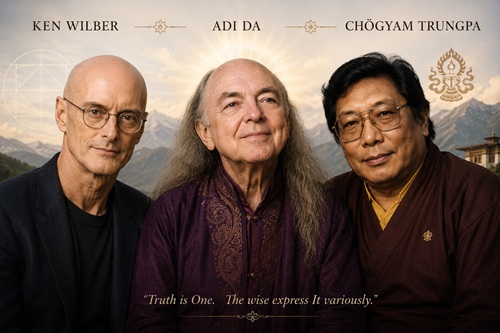 Somewhere beyond time—part Tibetan monastery, part California retreat center, part cosmic lecture hall—three controversial spiritual figures sit around a low wooden table. Incense curls upward. Tea is poured. Nobody agrees on anything. Present are Ken Wilber, architect of Integral Theory; Adi Da, ecstatic prophet of radical divine realization; and Chogyam Trungpa, founder of Shambhala Buddhism and notorious critic of spiritual pretension. Wilber begins, naturally, with a map. “Spirituality,” says Wilber, carefully arranging invisible quadrants in the air, “is not one thing. It unfolds developmentally. Human beings evolve through structures of consciousness—archaic, magic, mythic, rational, pluralistic, integral, and beyond. Mystical realization appears differently at each level.” Trungpa lights a cigarette. “You Americans,” he says softly, “always want spirituality to improve itself.” Adi Da bursts into laughter. “Improve? Evolution? Development?” He waves dismissively. “The Divine Condition is eternally already the case. Reality is not climbing a ladder toward God. Reality is God. The seeker is already avoiding the obvious.” Wilber smiles patiently. He has heard this before. “Yes, ultimate realization may be timeless. But human beings still develop psychologically, morally, cognitively. A Zen master can have nondual realization and still behave narcissistically if development in other lines is immature.” Trungpa nods approvingly. “That is true. Meditation does not deodorize ego. In fact, spirituality often becomes refined narcissism.” He leans forward. “People use spirituality to confirm themselves. They collect teachings, initiations, exotic experiences. This is what I called spiritual materialism.” Adi Da scoffs. “Because their practices are weak. They are not surrendering to the Divine Person.” “No,” says Trungpa, “because ego can survive almost anything.” A silence. Then Wilber interjects enthusiastically. “This is precisely why an integral approach matters. We need to include meditation, psychology, shadow work, social systems, embodiment, neuroscience—all of it. Traditional spirituality often ignored pathology.” Adi Da raises an eyebrow. “And modern psychology ignores God.” “Not entirely,” Wilber replies. “Transpersonal psychology—” “Transpersonal psychology,” Adi Da interrupts, “is mostly the ego studying altered states while remaining fundamentally self-contracted.” Trungpa laughs aloud. “That is actually quite accurate.” Wilber sighs. “You both criticize modernity while benefiting from it. The premodern traditions had enormous blind spots—mythic literalism, patriarchy, authoritarianism. Integral spirituality attempts to preserve contemplative depth while integrating modern rationality.” Trungpa nods slowly. “Yes. But rationality alone cannot wake you up.” “Exactly,” says Adi Da. “Nor can systems theory.” Wilber responds immediately. “I never said systems theory causes enlightenment. I'm saying spiritual realization expresses through structures. A mythic believer interprets mystical light one way; a postmodern pluralist interprets it another way. Context matters.” Adi Da leans back dramatically. “You are still describing the furniture of illusion. Enlightenment is not a developmental achievement. It is the death of the seeker in Divine Radiance.” Trungpa blows smoke toward the ceiling. “And then the dead seeker opens a nonprofit organization.” Wilber laughs despite himself. Trungpa continues. “Spirituality becomes dangerous when people use absolute truth to bypass relative truth. Teachers claim realization while exploiting students. Students surrender discernment in the name of transcendence.” Adi Da's expression hardens. “The true guru shatters egoic conventions.” “Yes,” says Trungpa dryly, “and false gurus say exactly the same thing.” Another silence descends. Outside, a bell rings somewhere in the imaginary distance. Wilber resumes in a quieter tone. “Perhaps spirituality has multiple valid dimensions. There is awakening—realization of ultimate reality. There is growing up—psychological and moral maturation. There is cleaning up—shadow integration. And showing up—ethical participation in the world.” Trungpa nods. “That is more useful.” Adi Da shrugs. “Useful for seekers, perhaps. But the highest spirituality is not self-improvement. It is self-transcendence in ecstatic communion with the Divine.” Trungpa studies him carefully. “And what if there is no Divine?” Adi Da smiles almost pityingly. “Then who is asking the question?” Wilber intercedes before metaphysics explodes completely. “Maybe spirituality is fundamentally about transformation of identity—from ego-centric to world-centric to kosmo-centric awareness.” Trungpa shakes his head. “The danger with grand frameworks is that people mistake describing transcendence for realizing it.” “And the danger with anti-intellectualism,” Wilber replies, “is romantic confusion.” Adi Da points upward. “The danger is separation from the Divine Beloved.” Trungpa points at the teacup. “The danger is believing your own performance.” For a rare moment, nobody speaks. Then Trungpa smiles mischievously. “You know, perhaps spirituality is simply becoming less full of nonsense.” Wilber grins. “That could fit into an integral framework.” Adi Da closes his eyes. “That framework itself is nonsense.” The three men laugh. And somewhere beyond doctrines, systems, gurus, and metaphysical claims, the conversation continues indefinitely.
Comment Form is loading comments...
|