|
TRANSLATE THIS ARTICLE
Integral World: Exploring Theories of Everything
An independent forum for a critical discussion of the integral philosophy of Ken Wilber
  Frank Visser, graduated as a psychologist of culture and religion, founded IntegralWorld in 1997. He worked as production manager for various publishing houses and as service manager for various internet companies and lives in Amsterdam. Books: Ken Wilber: Thought as Passion (SUNY, 2003), and The Corona Conspiracy: Combatting Disinformation about the Coronavirus (Kindle, 2020). Frank Visser, graduated as a psychologist of culture and religion, founded IntegralWorld in 1997. He worked as production manager for various publishing houses and as service manager for various internet companies and lives in Amsterdam. Books: Ken Wilber: Thought as Passion (SUNY, 2003), and The Corona Conspiracy: Combatting Disinformation about the Coronavirus (Kindle, 2020).
Check out my other conversations with ChatGPT Eros Ex MachinaHow Ken Wilber Smuggles Spirit into Complexity TheoryFrank Visser / ChatGPT
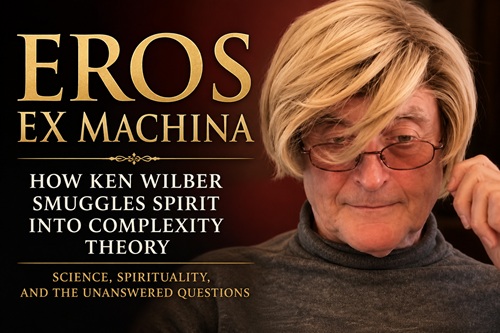 For decades, Ken Wilber has presented himself as the great integrator of science, spirituality, psychology, and philosophy. Central to his vision is the claim that evolution displays an intrinsic tendency toward greater complexity, consciousness, depth, and self-transcendence—a tendency he famously calls “Eros in the Kosmos.” The appeal is obvious. Wilber offers a universe that is not merely mechanical but meaningful; not random but directionally creative. Evolution, in his telling, is not simply adaptation through selection but the unfolding of Spirit itself. And yet the closer one examines the actual logic of the argument, the more elusive its foundations become. Wilber repeatedly invokes complexity science, systems theory, and self-organization research as if modern science were converging on his spiritual cosmology. But when pressed critically, he often retreats into claims about mystical experience and the limits of scientific knowledge. The result is a shifting argumentative structure in which Spirit appears scientific when convenient and trans-scientific when challenged. This ambiguity is not incidental. It is foundational to how Wilber's system operates. The Sailboat and the WindA useful image exposes the problem. Complexity theorists frequently describe order as arising from energy flowing through matter under far-from-equilibrium conditions. Organisms, ecosystems, and even civilizations are interpreted as dissipative structures sustained by energetic throughput. The image that naturally comes to mind is a sailboat harnessing the wind. But the wind did not create the boat. The wind supplies energy. The boat supplies organization. This distinction matters because it reveals a persistent confusion in many popular discussions of complexity. Energy flow alone does not explain structure. It explains activity, not architecture. A hurricane self-organizes. So does a crystal. So do convection cells in heated fluids. Yet none of these phenomena imply cosmic intentionality, spiritual striving, or metaphysical purpose. They are examples of patterned dynamics emerging under physical constraints. The real explanatory challenge lies elsewhere: • how constraints emerge, • how information accumulates, • how organization stabilizes, • and how increasingly adaptive structures are retained historically. This is where thinkers like Stuart Kauffman and Ilya Prigogine become important. What Complexity Theory Actually SaysKauffman did not reject Darwinian evolution. He accepted natural selection as indispensable for explaining biological adaptation. His point was subtler. Darwin explains how viable forms are selected. But what explains the spontaneous emergence of organized systems upon which selection can operate in the first place? Kauffman proposed that self-organization constitutes an additional “origin of order.” Under certain conditions, chemical networks may naturally form autocatalytic systems capable of self-maintenance and increasing complexity. Prigogine similarly demonstrated that far-from-equilibrium systems can spontaneously generate ordered structures through dissipative dynamics. These were important scientific insights. But neither Kauffman nor Prigogine concluded that the universe is animated by Spirit. Neither claimed that evolution possesses intrinsic metaphysical intentionality. Neither discovered a cosmic force equivalent to Wilber's Eros. That leap belongs entirely to Wilber. The Strategic LeapWilber's reasoning often proceeds in four stages: • Darwinian selection alone seems insufficient. • Complexity science demonstrates spontaneous self-organization. • Therefore evolution exhibits an intrinsic drive toward greater order and consciousness. • That drive is what Wilber calls “Eros.” The first two claims are scientifically respectable. The third is philosophically debatable. The fourth is metaphysical. Yet Wilber frequently presents the progression as though the final step naturally emerges from the preceding science. Readers are subtly encouraged to believe that modern complexity theory is rediscovering Spirit under secular terminology. But under critical scrutiny, Wilber has occasionally admitted something far more revealing: • Kauffman does not believe in Spirit. • Prigogine did not believe in Spirit. • Dawkins and Mayr certainly did not believe in Spirit. • Wilber himself adds Eros because he believes science leaves crucial problems unsolved. This admission fundamentally changes the nature of the argument. The claim is no longer: “Science increasingly supports Spirit.” It becomes: “Science has explanatory gaps, therefore I infer Spirit.” That is not scientific convergence. It is metaphysical supplementation. Eros as a God-of-the-Gaps PrincipleOnce stated openly, Wilber's position begins to resemble a sophisticated form of “God of the gaps” reasoning. • The origin of life remains incompletely understood. • Consciousness remains mysterious. • Increasing complexity appears remarkable. Therefore, Wilber inserts Eros. But explanatory incompleteness does not license metaphysical conclusions. Open scientific questions do not automatically validate spiritual teleology. One may legitimately argue that current naturalistic explanations remain incomplete. What does not follow is that Spirit therefore becomes the best explanation. Other possibilities remain entirely open: • future scientific advances, • emergentist models, • neutral monism, • panpsychism, • or simply continued uncertainty. Wilber's Eros is not derived from the science. It is layered onto the science. The Retreat into the InteriorWhen scientific objections become sharper, Wilber often shifts to another line of defense. Science, he argues, studies only the exterior or “It” dimensions of reality. Spirit becomes accessible instead through contemplative practice, mystical realization, and the interior domains of consciousness—the “I” and “We” dimensions in his AQAL framework. Again, this sounds sophisticated. But rhetorically it serves an important function. When complexity science appears suggestive, Wilber invokes it as support for Eros. When science fails to support Eros, he argues that science is incapable of accessing Spirit in the first place. This allows his position to oscillate between empirical suggestion and mystical immunity. • Spirit is scientifically implied when advantageous. • Spirit is beyond science when criticized. The target keeps moving. Experience Is Not OntologyNone of this requires dismissing contemplative experience. Mystical states are real experiences. Meditation can produce profound transformations: • unity experiences, • ego dissolution, • altered states of awareness, • feelings of sacredness and interconnectedness. But experiences do not interpret themselves. The same kinds of contemplative experiences have generated radically different metaphysical conclusions across cultures: • Buddhist emptiness, • Advaita nondualism, • Christian mysticism, • Sufi theology, • idealism, • panpsychism, • naturalistic spirituality. Wilber repeatedly moves too quickly from phenomenology to ontology—from “humans experience transcendence” to “the universe itself is spiritually driven.” That leap requires philosophical argument, not rhetorical association. The Ontological EvasionThe central question Wilber rarely answers with precision is deceptively simple: What exactly is Eros? Is it: • a metaphor? • a poetic intuition? • a statistical tendency? • a teleological principle? • a metaphysical force? • divine intentionality? • an actual causal factor in evolution? At different moments, Wilber implies all of these simultaneously. Most revealingly, he once described Eros as “as real as the four fundamental forces of physics.” But unlike gravity or electromagnetism, Eros has: • no measurable properties, • no equations, • no predictive capacity, • no operational definition, • and no independent empirical detection. Its explanatory role remains elastic and unfalsifiable. • Scientific when useful. • Mystical when challenged. • Metaphorical when cornered. • Ontological when inspiring. Hence: Eros Ex Machina. Complexity Without Cosmic SpiritModern complexity science genuinely transformed our understanding of nature. Self-organization, emergence, network dynamics, and far-from-equilibrium systems are real phenomena requiring serious explanation. But none of this logically entails cosmic spirituality. Energy gradients, constraint structures, historical selection, and informational accumulation already provide powerful frameworks for understanding increasing complexity without invoking metaphysical intentionality. Those frameworks remain incomplete. Science still faces profound open questions. But “not yet fully explained” is not the same as “therefore Spirit.” Wilber's enduring mistake is not that he values spirituality. It is that he repeatedly presents speculative metaphysics as though they are strongly suggested by scientific developments that, on careful inspection, remain entirely compatible with naturalistic interpretations. If Wilber wishes to defend Eros as a metaphysical worldview, he is entitled to do so. But intellectual clarity demands that he finally state openly: • where empirical science ends, • where metaphysical interpretation begins, • and why the leap to Spirit is justified at all.
Comment Form is loading comments...
|