|
TRANSLATE THIS ARTICLE
Integral World: Exploring Theories of Everything
An independent forum for a critical discussion of the integral philosophy of Ken Wilber
  Frank Visser, graduated as a psychologist of culture and religion, founded IntegralWorld in 1997. He worked as production manager for various publishing houses and as service manager for various internet companies and lives in Amsterdam. Books: Ken Wilber: Thought as Passion (SUNY, 2003), and The Corona Conspiracy: Combatting Disinformation about the Coronavirus (Kindle, 2020). Frank Visser, graduated as a psychologist of culture and religion, founded IntegralWorld in 1997. He worked as production manager for various publishing houses and as service manager for various internet companies and lives in Amsterdam. Books: Ken Wilber: Thought as Passion (SUNY, 2003), and The Corona Conspiracy: Combatting Disinformation about the Coronavirus (Kindle, 2020).
Check out my other conversations with ChatGPT Eros and Final CausesWilber's Teleology in the Light of AristotleFrank Visser / ChatGPT
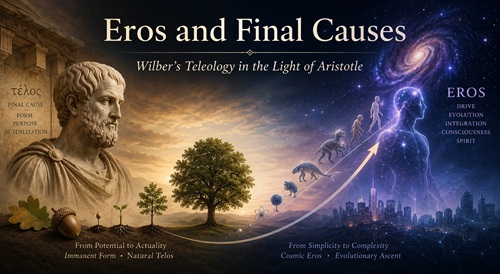 Introduction: Two Teleological LanguagesKen Wilber's concept of “Eros” and Aristotle's doctrine of “final causes” both attempt to explain why reality appears directional rather than merely mechanical. Each introduces a form of intrinsic purposiveness into nature. Yet they arise from radically different metaphysical frameworks: Aristotle operates within an immanent, form-driven ontology of substances, while Wilber embeds teleology in an evolutionary, quasi-cosmic spiritual dynamism that often oscillates between metaphor and metaphysics. Comparing the two clarifies both the continuity and the conceptual inflation involved in Wilber's appropriation of teleology. Aristotle's Final Causes: Immanent Form and ActualizationFor Aristotle, final causes (telos) are not external purposes imposed on nature but internal principles of organization. Every substance has a form that determines its proper development: an acorn tends toward an oak, not because it is “pulled” by a future oak, but because its essence is structured toward that outcome. Teleology here is not cosmic intention but immanent actuality-in-potency. In Aristotelian biology and metaphysics, final causes are tightly integrated with material, formal, and efficient causes. They are not mystical additions; they are explanatory placeholders for intelligible order in natural processes. Importantly, Aristotle does not require an overall cosmic drive toward “higher complexity” or progressive evolution. The telos is local, species-relative, and grounded in form rather than historical ascent. Wilber's Eros: Evolutionary Drive Toward Complexity and ConsciousnessWilber's “Eros” is a far more expansive and ambiguous principle. It is described as a self-organizing, intrinsic drive of the Kosmos toward greater complexity, integration, and eventually consciousness and spirit. In some formulations it is presented as an ontological tendency embedded in reality itself; in others it is softened into a “general push” or “rough directive” that coexists with chance and contingency. Unlike Aristotle's localized teleology, Wilber's Eros is explicitly evolutionary and cosmological. It stretches across biological, psychological, cultural, and spiritual domains, suggesting a single underlying vector of ascent from matter to mind to spirit. It is thus not merely explanatory but strongly directional and hierarchical, often aligning complexity with value and higher stages with ontological superiority. Structural Similarities: Intrinsic DirectionalityAt a superficial level, Wilber's Eros resembles Aristotelian final causality in that both reject a purely mechanistic universe. Both assume that natural processes are not random aggregations but internally organized toward some form of realization. Both also resist reductionism. Aristotle resists reducing organisms to matter alone; Wilber resists reducing evolution to blind mutation and selection. In both cases, explanation requires reference to something like “form” or “pattern” that cannot be captured by efficient causation alone. Critical Divergence I: Local Form vs Global TeleologyThe most significant divergence lies in scale. Aristotle's final causes are immanent to individual substances and species. They do not require a cosmic narrative of progress. An oak tree does not represent a “higher stage” than an acorn in a value-laden evolutionary hierarchy; it is simply the actualization of that acorn's form. Wilber, by contrast, embeds teleology in a grand developmental arc. Eros becomes a universal principle of ascent, implying that evolution is not merely actualization but progressive transcendence. This introduces a global directional bias absent in Aristotle. The result is a shift from explanatory teleology to metaphysical narration: Aristotle explains what a thing is doing; Wilber explains what everything is supposedly doing together. Critical Divergence II: Ontological Modesty vs Metaphysical InflationAristotle's final causes are epistemically modest. They function as explanatory principles grounded in empirical observation of organisms and their development. They do not claim access to cosmic intention. Wilber's Eros, however, often oscillates between metaphorical description and ontological assertion. At times it reads as a poetic way of describing self-organization; at others it becomes a quasi-cosmic agency embedded in reality. This ambiguity allows Eros to function rhetorically as both scientific compatibility claim and spiritual principle. This inflation becomes especially visible when Wilber aligns Eros with “Spirit-in-action,” effectively collapsing explanatory teleology into spiritual metaphysics. Critical Divergence III: Absence of Empirical ConstraintAristotelian teleology, while pre-modern, remains constrained by observational biology: forms are inferred from stable patterns in nature. Wilber's Eros, by contrast, is not tightly constrained by empirical falsifiability. It is compatible with virtually any evolutionary outcome, since complexity, integration, or consciousness can be retrospectively interpreted as expressions of the same drive. This makes Eros less a causal hypothesis and more an interpretive framework applied after the fact to evolutionary history. The Hidden Tension: Teleology Without Determinate FormAristotle's teleology works because “form” is determinate. An organism's telos is definable in relation to its species essence. Wilber replaces this with an open-ended gradient of complexity and consciousness, but without a clearly defined endpoint other than increasingly abstract notions of integration. This creates a conceptual tension: if Eros is truly directional, its endpoint should be specifiable; if it is not, then it risks becoming a retrospective interpretive overlay rather than a causal principle. Conclusion: From Immanent Form to Cosmic NarrativeWilber's Eros can be seen as a modern, evolutionized transformation of teleological thinking, but it departs significantly from Aristotle's disciplined framework. Where Aristotle offers a restrained account of immanent purposiveness grounded in form, Wilber constructs a sweeping cosmological narrative of ascent. The comparison reveals not continuity but translation with distortion: final causes become cosmic momentum, and local actuality becomes global progression. Aristotle's teleology explains how beings realize what they already are; Wilber's Eros often suggests that beings are on their way to becoming something higher than what they are. The philosophical cost of this shift is clarity. The metaphysical gain is narrative power.
Comment Form is loading comments...
|