|
TRANSLATE THIS ARTICLE
Integral World: Exploring Theories of Everything
An independent forum for a critical discussion of the integral philosophy of Ken Wilber
  Frank Visser, graduated as a psychologist of culture and religion, founded IntegralWorld in 1997. He worked as production manager for various publishing houses and as service manager for various internet companies and lives in Amsterdam. Books: Ken Wilber: Thought as Passion (SUNY, 2003), and The Corona Conspiracy: Combatting Disinformation about the Coronavirus (Kindle, 2020). Frank Visser, graduated as a psychologist of culture and religion, founded IntegralWorld in 1997. He worked as production manager for various publishing houses and as service manager for various internet companies and lives in Amsterdam. Books: Ken Wilber: Thought as Passion (SUNY, 2003), and The Corona Conspiracy: Combatting Disinformation about the Coronavirus (Kindle, 2020).
Check out my other conversations with ChatGPT The Donbas DilemmaWhy Territorial Compromise Fails to Resolve a Systemic Security ConflictFrank Visser / ChatGPT
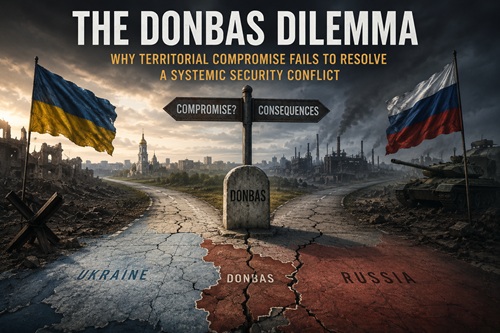 A useful way to approach the Ukraine war is to separate three levels that often get collapsed in public debate: legal sovereignty, security architecture, and territorial compromise. The current “stalemate” arises because each narrative selects one level as primary and treats the others as secondary or irrelevant. Any proposed “elegant solution” like ceding Donbas to Russia only looks elegant if one brackets at least one of those levels. Once they are all taken seriously simultaneously, the apparent simplicity dissolves. Two competing narratives, two different starting axiomsThe first narrative is rooted in international law and the post-1945 European order: Ukraine is a sovereign state with internationally recognized borders, and Russia's 2022 invasion constitutes a violation of the UN Charter and the Helsinki Final Act principles. On this view, the core problem is not ambiguity but enforcement failure. If territorial conquest is allowed to stand, the precedent destabilizes the entire European security system, particularly for states like Estonia, Latvia, and Lithuania, which rely heavily on deterrence guarantees and alliance credibility. The second narrative is rooted in a geopolitical and security-expansion framework: NATO enlargement and Western political influence in Ukraine are seen as incremental encroachment into Russia's perceived buffer zone. From this perspective, the war is interpreted less as a sudden rupture and more as the violent culmination of a long security dilemma, in which each side interprets defensive moves by the other as offensive positioning. These are not simply “opinions about facts,” but competing hierarchies of relevance. One prioritizes legal order, the other prioritizes security equilibrium. Why Donbas appears as a “clean compromise”On a purely surface-level geopolitical calculus, transferring Donbas (or formalizing Russian control over it) looks like a stabilizing compromise for three reasons. First, it acknowledges de facto control on the ground. Russia has occupied parts of Donetsk and Luhansk since 2014, and full-scale war since 2022 has entrenched that control. Second, it appears to reduce escalation risk. If Russia's minimum territorial demands are met, the argument goes, Moscow would have less incentive to expand the war westward or deepen mobilization. Third, it resembles historical settlement patterns in frozen conflicts: partition or territorial adjustment is sometimes used to stop active warfare when no side can decisively prevail. From a purely conflict-management perspective, this is the “elegant solution”: freeze the line, legalize reality, and stop the killing. Why this “elegance” breaks down under legal and systemic pressureThe first problem is legal normalization of conquest. Accepting territorial transfer under military pressure undermines the foundational principle of post-WWII European order: borders are not to be changed by force. Once that principle is weakened in one case, it becomes harder to credibly enforce elsewhere. This is why states bordering Russia, particularly in the Baltics, view the precedent as existential rather than abstract. The second problem is incentive structure. A settlement that rewards territorial acquisition through war risks creating a strategic template: if force yields durable territorial gain, then future disputes may rationally escalate to force. This is a classic deterrence problem—what looks like compromise in one case can function as incentive in the next iteration. The third problem is that Donbas is not just a territorial unit but embedded in a larger strategic claim. Russia's stated and implied security objectives have extended beyond Donbas at various points in the conflict, including denial of Ukraine's NATO trajectory and broader influence over its political orientation. That means ceding Donbas may not satisfy the underlying security demand, but instead become one step in a sequence of demands. The Ukrainian internal constraint: sovereignty is not divisible without consequenceFrom Ukraine's perspective, territorial concessions are not merely geographic adjustments but constitutional and identity-level ruptures. Ukraine's post-1991 statehood is built on territorial integrity as a baseline condition of political legitimacy. Ceding Donbas under coercion risks destabilizing internal cohesion, especially given the precedent of Crimea in 2014 and subsequent escalation. In practical terms, any Ukrainian government that formally accepts forced territorial loss risks domestic political collapse or radicalization, which in turn undermines the stability that the “compromise” was supposed to achieve. The core stalemate: incompatible definitions of securityThe deeper reason no “elegant solution” holds is that the two narratives define security in mutually incompatible ways. For Ukraine and its Western partners, security means territorial integrity guaranteed by rules and alliances. For Russia, security is framed as strategic depth and exclusion of rival military blocs from its near periphery. For one side, stability requires fixed borders backed by deterrence commitments. For the other, stability requires flexible borders adjusted to geopolitical balance. Donbas sits at the intersection of these definitions, which is why it cannot function as a neutral bargaining chip. Any settlement there implicitly validates one security logic and invalidates the other. Why frozen solutions tend to re-igniteHistorically, partial territorial settlements under unresolved strategic disputes tend to become frozen conflicts rather than final ones. They reduce immediate violence but often preserve the underlying incompatibility. Examples in post-Soviet space (Transnistria, Abkhazia, South Ossetia) illustrate that “stability” achieved via de facto partition often stabilizes only the front line, not the underlying conflict logic. Donbas, under a forced transfer model, would likely function similarly: a ceasefire without closure. The real constraint: no mutually acceptable equilibrium exists at presentThe key issue is not whether compromise is desirable in abstract, but whether a stable equilibrium exists that simultaneously satisfies: • Ukrainian sovereignty and internal legitimacy • Russian security claims as currently articulated • European deterrence credibility and alliance signaling At present, no configuration fully satisfies all three. Any “elegant solution” necessarily drops at least one constraint, and that is where its elegance dissolves. Conclusion: Why Donbas feels simple but is structurally insolubleTurning Donbas into a negotiated territorial transfer appears elegant because it reduces a multidimensional conflict into a single variable: land. But the war is not primarily about land; it is about incompatible security architectures and competing interpretations of post-Cold War order. This is why the stalemate persists. The solution space is not blocked by lack of creativity, but by the fact that each “clean” solution stabilizes one dimension only by destabilizing another. In such cases, what looks like pragmatism on the surface is usually just a shift of instability into a different layer of the system.
Comment Form is loading comments...
|