|
TRANSLATE THIS ARTICLE
Integral World: Exploring Theories of Everything
An independent forum for a critical discussion of the integral philosophy of Ken Wilber
  Frank Visser, graduated as a psychologist of culture and religion, founded IntegralWorld in 1997. He worked as production manager for various publishing houses and as service manager for various internet companies and lives in Amsterdam. Books: Ken Wilber: Thought as Passion (SUNY, 2003), and The Corona Conspiracy: Combatting Disinformation about the Coronavirus (Kindle, 2020). Frank Visser, graduated as a psychologist of culture and religion, founded IntegralWorld in 1997. He worked as production manager for various publishing houses and as service manager for various internet companies and lives in Amsterdam. Books: Ken Wilber: Thought as Passion (SUNY, 2003), and The Corona Conspiracy: Combatting Disinformation about the Coronavirus (Kindle, 2020).
Check out my other conversations with ChatGPT The Other Wilber UniverseWhy the Integral/Science Debate Never Became Central to the Integral MovementFrank Visser / ChatGPT
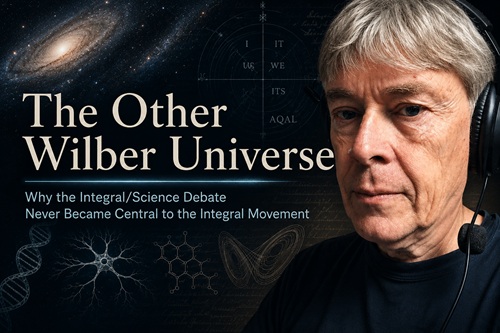 For decades I have had the strange feeling of living in a parallel Wilber universe. Around the original Integral movement, countless spin-offs and derivative approaches have emerged: integral coaching, integral leadership, integral spirituality, integral education, integral ecology, developmental politics, systems transformation, shadow work, and consciousness studies. Yet remarkably few of these ventures seriously engage the issues that have occupied me relentlessly for years: the relationship between Integral Theory and science, the validity of Wilber's metaphysical claims, and the evidential basis for concepts such as Eros, involution, and spiritualized evolution. This raises an obvious question: why has this line of critique never attracted a larger audience within the integral world itself? The answer lies partly in the sociology of the movement, partly in the psychology of spiritual worldviews, and partly in the uncomfortable nature of the questions being asked. The Dangerous Fault LineThe interface between Integral Theory and science is not a side issue. It is the central stress test of the entire system. Ken Wilber repeatedly presented his work as a grand synthesis capable of integrating science, spirituality, psychology, philosophy, and culture into a coherent “theory of everything.” Such an ambition inevitably invites scrutiny from the scientific perspective. Once Integral Theory makes claims about evolution, cosmology, consciousness, quantum physics, complexity, or developmental dynamics in nature, it enters territory governed by standards of evidence and conceptual rigor. But this is precisely where the movement becomes uneasy. Many integral thinkers prefer to operate in safer domains: • personal development, • organizational consulting, • contemplative practice, • developmental psychology, • leadership training, • social transformation. These fields allow Integral Theory to function as an interpretive framework without requiring strong empirical validation. The moment one begins examining Wilber's metaphysical assertions literally, however, the atmosphere changes. Questions arise that are difficult to answer persuasively: • Is Eros in the Kosmos an explanatory principle or a poetic metaphor? • Does evolution display intrinsic spiritual directionality? • Is involution anything more than mythological backstory? • Are references to quantum physics scientifically meaningful or rhetorically decorative? • Can spirituality legitimately claim explanatory authority over biological evolution? These questions destabilize the movement because they strike at its metaphysical core. The Shift Away from MetaphysicsOver time, many integral practitioners appear to have solved this problem pragmatically rather than philosophically. They gradually shifted emphasis away from Wilber's grand cosmology and toward more practical, psychological, and developmental applications. In effect, the movement secularized itself without openly admitting it. Developmental models survived because they are pragmatically useful. Systems thinking survived because it applies to organizations and culture. Meditation survived because people experience benefits from contemplative practice. But concepts like involutionary Spirit driving evolution increasingly faded into the background, often treated more as symbolic language than literal cosmology. This quiet transition explains why critiques of Wilber's metaphysics frequently fail to generate widespread engagement. Many integralists no longer rely existentially on those claims, even if they still admire Wilber's larger vision. The metaphysics became optional. The inspiration remained. Meaning Versus AnalysisAnother reason for the limited audience lies in the differing motivations of participants. Many people approach Integral Theory seeking orientation, meaning, synthesis, or spiritual depth. They are not necessarily looking for analytic rigor or scientific adjudication. Integral functions for them as a worldview that reconciles modernity with spirituality. My own approach has always been different. I treat Integral Theory as a set of claims requiring examination. I ask: • Are the scientific references accurate? • Are the conclusions justified? • Is complexity theory being overstretched? • Are metaphorical statements presented as factual insights? • Is spirituality quietly replacing evidence? This is less an act of spiritual participation than intellectual audit. For many readers, that mode of engagement feels disruptive. A worldview that functions existentially can react defensively when subjected to analytic dissection. Criticism is then perceived not merely as disagreement but as desecration. To critique Eros scientifically may feel, to some integralists, like reducing a cathedral to molecular chemistry. The Reductionism ReflexIntegral culture developed a particularly effective defense mechanism against scientific criticism: the accusation of reductionism. Whenever scientific objections arise, critics are often told they: • “don't understand higher consciousness,” • are trapped in “flatland thinking,” • mistake quantitative analysis for full-spectrum knowing, • fail to appreciate interior dimensions, • reduce Spirit to matter. This rhetorical move has considerable emotional power because reductionism is indeed a real philosophical danger. Human experience cannot simply be collapsed into mechanism. However, the accusation often becomes overextended. It functions not merely as a critique of narrow scientism, but as a shield protecting weak metaphysical claims from evidential scrutiny. The problem is not that spirituality exists. The problem is when speculative metaphysics borrows the prestige of science without accepting scientific accountability. That is the issue I have consistently pursued. The Narrow CorridorThere is also a structural problem of audience. Mainstream scientists generally ignore Integral Theory altogether. To them, it appears vague, metaphysical, or culturally peripheral. They do not see it as an intellectual competitor requiring engagement. Meanwhile, committed integral audiences often resist sustained scientific critique because it threatens cherished assumptions about consciousness, evolution, and spiritual development. This leaves critics like myself occupying a very narrow corridor: • too scientific for many spiritual readers, • too spiritual for scientific skeptics, • too specialized for general audiences, • too critical for loyal followers, • too historically informed for casual consumers. It is not an ideal formula for mass popularity. The Attention Economy ProblemContemporary media culture further intensifies this marginalization. Online attention systems reward: • certainty, • tribal affirmation, • emotional reassurance, • inspirational narratives, • ideological clarity, • simplified conflict. Careful conceptual critique performs poorly within such an environment. Intellectual nuance spreads slowly. Detailed analysis rarely competes successfully with emotionally satisfying narratives. Integral spirituality offers uplift and cosmic orientation. Scientific critique offers complication and ambiguity. Most audiences instinctively gravitate toward the former. The Unresolved Core QuestionYet despite the movement's gradual shift away from explicit metaphysics, the central question never disappeared: Are Wilber's grand spiritual claims actually true? • Not useful. • Not inspiring. • Not psychologically meaningful. • But true. Does evolution really contain intrinsic spiritual purpose? Is Eros an ontological force? Is Spirit genuinely active within cosmic development? Or are these mythopoetic projections layered onto naturalistic processes? This question remains unresolved because the movement largely stopped confronting it directly. Instead, many integral practitioners learned to live comfortably in ambiguity: • using developmental language pragmatically, • treating metaphysical claims symbolically, • preserving inspiration while softening literalism. But some of us continued pressing the issue. The Historical Role of CritiqueIn retrospect, my role within the integral world may never have been to expand the movement, but to preserve intellectual accountability within it. Movements centered on synthesis often resist internal criticism because critique threatens coherence. Yet without critique, synthesis gradually drifts into self-protective mythology. For decades I have documented the tension between Integral Theory's scientific aspirations and its metaphysical tendencies. That work may never attract a mass audience. But historical significance and popularity are not the same thing. The integral movement largely learned how to sidestep the science problem. I simply refused to let the question disappear.
Comment Form is loading comments...
|