|
TRANSLATE THIS ARTICLE
Integral World: Exploring Theories of Everything
An independent forum for a critical discussion of the integral philosophy of Ken Wilber
  Frank Visser, graduated as a psychologist of culture and religion, founded IntegralWorld in 1997. He worked as production manager for various publishing houses and as service manager for various internet companies and lives in Amsterdam. Books: Ken Wilber: Thought as Passion (SUNY, 2003), and The Corona Conspiracy: Combatting Disinformation about the Coronavirus (Kindle, 2020). Frank Visser, graduated as a psychologist of culture and religion, founded IntegralWorld in 1997. He worked as production manager for various publishing houses and as service manager for various internet companies and lives in Amsterdam. Books: Ken Wilber: Thought as Passion (SUNY, 2003), and The Corona Conspiracy: Combatting Disinformation about the Coronavirus (Kindle, 2020).
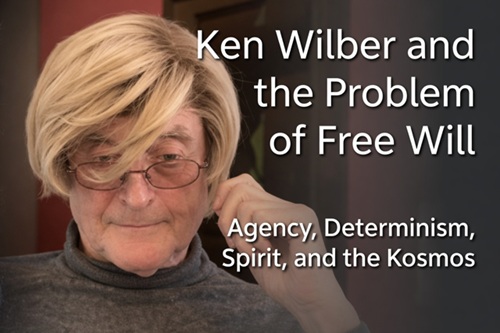
Check out my other conversations with ChatGPT Ken Wilber and the Problem of Free WillAgency, Determinism, Spirit, and the KosmosFrank Visser / ChatGPT
 The debate over free will is one of the oldest and most persistent in philosophy. Are human beings genuinely free agents capable of making meaningful choices, or are our actions determined by prior causes—biological, psychological, social, or even cosmic? Modern neuroscience has intensified this debate by suggesting that decisions may be initiated unconsciously before we become aware of them. Against this background, the position of Ken Wilber is both distinctive and elusive. Wilber rarely wrote a dedicated treatise on free will. Unlike philosophers such as Daniel Dennett or Sam Harris, he did not frame the issue primarily in terms of analytic philosophy or neuroscience. Instead, his position emerges indirectly from his broader metaphysical system: Integral Theory, AQAL (“all quadrants, all levels”), evolutionary spirituality, and his understanding of consciousness. To understand Wilber on free will, one must reconstruct his views from across his work. The result is a complex and sometimes internally unstable position: partly developmental psychology, partly systems theory, partly Vedantic mysticism, and partly cosmic teleology. Wilber rejects both crude determinism and naive libertarian free will. Yet he also avoids a fully materialist understanding of human agency. Instead, he embeds freedom within an evolving Kosmos animated by Spirit or Eros. This makes his view simultaneously spiritual, developmental, and metaphysical. The Integral Context: Freedom Across the Four QuadrantsWilber's AQAL framework divides reality into four dimensions or “quadrants”: • Interior-individual (“I”) — consciousness, intentions, subjective experience. • Exterior-individual (“It”) — brain, body, behavior. • Interior-collective (“We”) — culture, values, worldview. • vExterior-collective (“Its”) — social systems, ecology, institutions. In discussions of free will, most philosophers focus mainly on the exterior-individual quadrant: neurons, causality, behavior, and brain processes. Wilber criticizes this as “flatland reductionism.” He argues that human agency cannot be reduced to brain mechanics because intentionality, meaning, and subjective awareness are irreducible features of reality. For Wilber, freedom exists differently in different quadrants. From the exterior perspective, behavior may appear causally determined. Brain states follow physical laws. Genetic influences constrain personality. Social conditioning shapes thought. But from the interior perspective, human beings experience themselves as agents capable of reflection, self-transcendence, and intentional action. Wilber insists that both perspectives are valid simultaneously. This allows him to evade strict reductionism without fully denying causality. Holons and Relative AutonomyA central concept in Wilber's philosophy is the “holon,” borrowed from Arthur Koestler. A holon is something that is simultaneously a whole and part of a larger whole. Atoms, cells, organisms, and societies are all holons. Each holon possesses what Wilber calls “agency” and “communion”: • Agency: the tendency to preserve its own individuality. • Communion: the tendency to integrate into larger wholes. This notion already implies a limited form of freedom. Holons are not merely passive objects pushed around by external forces. They possess some degree of self-organizing capacity and self-direction. Wilber often speaks of “self-transcendence,” meaning that systems evolve beyond their previous forms. Molecules become cells, cells become organisms, organisms become minds. In this framework, freedom is not absolute independence from causality. Rather, it is increasing depth of self-organization and self-awareness. A rock has almost no freedom. A reptile has instinctive behavioral flexibility. A human being has symbolic cognition, self-reflection, and moral deliberation. Thus, free will becomes developmental. The more consciousness evolves, the greater the potential freedom. Developmental FreedomWilber's psychology is deeply influenced by developmental theorists such as Jean Piaget, Lawrence Kohlberg, and Jane Loevinger. Human beings progress through increasingly complex stages of consciousness. At lower stages, individuals are largely driven by impulses, tribal conformity, or rigid ideology. At higher stages, individuals become capable of greater perspective-taking, self-reflection, and autonomy. Freedom therefore depends on developmental altitude. For Wilber, many people who believe they are exercising free will are actually enacting unconscious conditioning from earlier developmental structures. Their beliefs, desires, and identities are socially programmed. Real freedom emerges only through increased awareness. This resembles spiritual traditions in which ordinary consciousness is viewed as mechanical or asleep. Wilber synthesizes this idea with developmental psychology. The ego thinks it is free, but it is mostly reactive. Higher consciousness allows greater detachment from conditioning. In this sense, Wilber's view resembles compatibilism—the philosophical position that freedom can exist within causality—but with a spiritual-developmental twist. Meditation and Witness ConsciousnessWilber's engagement with Eastern spirituality profoundly shapes his understanding of agency. Drawing from Advaita Vedanta and Buddhism, he frequently distinguishes between the egoic self and deeper awareness. Meditative practice reveals that thoughts, emotions, and impulses arise spontaneously in consciousness. One does not consciously manufacture each thought. They simply appear. This observation aligns surprisingly well with modern neuroscience critiques of free will. Yet Wilber does not conclude, as Sam Harris often does, that free will is therefore an illusion. Instead, he argues that awareness itself—the witnessing consciousness behind mental events—opens a deeper form of freedom. The ordinary ego may not be fully autonomous, but consciousness can progressively disidentify from conditioned patterns. Freedom becomes less about “the ego choosing” and more about liberation from compulsive identification. This is a very Eastern conception of freedom. In Western philosophy, free will usually means voluntary decision-making. In contemplative spirituality, freedom means release from attachment and ignorance. Wilber blends these traditions together. Eros and Cosmic DirectionalityThe most controversial dimension of Wilber's view concerns evolution itself. Wilber repeatedly argues that evolution displays a tendency toward increasing complexity, consciousness, and depth. He calls this force “Eros.” Eros is not merely biological adaptation. It is an intrinsic drive toward self-transcendence within the Kosmos. This has major implications for free will. If the universe itself contains an immanent drive toward greater consciousness, then human agency participates in a larger evolutionary movement. Freedom becomes cosmological. Human beings are not isolated choosers in a meaningless universe. They are expressions of Spirit-in-action. Critics argue that this borders on teleology or even disguised creationism. Wilber denies advocating an anthropomorphic designer, but his language often implies purposive evolution. He rejects the neo-Darwinian view that complexity emerges through blind variation and selection alone. Instead, he insists that there is a directional tendency built into reality itself. This introduces tension into his theory. If Eros drives evolution toward higher consciousness, then how free are individuals really? Is human development genuinely open-ended, or are beings unconsciously carried along by a cosmic spiritual current? Wilber never fully resolves this ambiguity. Wilber Versus Scientific DeterminismWilber strongly opposes reductionistic neuroscience when it dismisses consciousness as merely neural activity. Thinkers such as Sam Harris often argue that free will is illusory because unconscious neural events precede conscious decisions. Wilber would likely accept the empirical findings while rejecting the metaphysical interpretation. For him, the mistake lies in reducing first-person experience to third-person observation. Brain scans reveal correlates of thought, not the entirety of consciousness itself. Wilber repeatedly argues that science is methodologically restricted to exterior phenomena. It can study behavior and neural patterns but cannot exhaustively explain interior awareness. Thus, he critiques what he calls “scientism,” the belief that scientific materialism provides a complete account of reality. However, critics note that Wilber often substitutes metaphysical speculation for empirical explanation. His appeals to Spirit, Eros, and higher consciousness are difficult to operationalize scientifically. The Nondual ResolutionAt the highest levels of Wilber's system, the free will debate dissolves altogether. Drawing from nondual traditions, Wilber ultimately claims that the separate self is illusory. The individual self and the Kosmos are expressions of a deeper nondual reality: Spirit. From this perspective, the question “Do I have free will?” becomes fundamentally mistaken because the isolated “I” does not ultimately exist. There is only the spontaneous unfolding of Spirit. This resembles aspects of Advaita Vedanta, Zen Buddhism, and certain mystical traditions. Paradoxically, this can sound very close to determinism. The separate ego is not independently controlling reality. Yet Wilber interprets this not as imprisonment but as liberation. Freedom lies in realizing one's identity with the larger process of existence itself. The wave discovers it is the ocean. Internal Tensions in Wilber's PositionWilber's approach to free will contains several unresolved tensions. First, he simultaneously emphasizes developmental conditioning and spiritual freedom. If individuals are heavily shaped by developmental structures, cultural systems, and unconscious drives, the scope of genuine autonomy becomes unclear. Second, his notion of Eros introduces quasi-teleological causation into evolution. This risks undermining the spontaneity and openness associated with freedom. Third, his nondual metaphysics can blur the distinction between agency and cosmic unfolding. If Spirit is ultimately doing everything, then personal free will may evaporate into mystical monism. Fourth, Wilber often oscillates between psychological language and metaphysical claims. At times he sounds like a developmental psychologist describing cognitive complexity; at other times he sounds like a cosmic mystic describing divine self-unfolding. These layers do not always cohere neatly. Comparison with Other PositionsWilber differs sharply from hard determinists like Sam Harris, who see conscious will as largely illusory. He also differs from classical libertarian theories of free will that posit an independent soul making unconstrained choices. His position is closest to a spiritually expanded compatibilism: • Human behavior is conditioned. • Consciousness can become more aware of conditioning. • Greater awareness increases relative freedom. • Ultimate freedom lies in spiritual realization. This approach integrates psychology, systems theory, meditation, and metaphysics into a single framework. Whether it succeeds philosophically is another question. ConclusionKen Wilber's view of free will cannot be separated from his broader Integral worldview. He rejects reductionistic determinism because he believes consciousness possesses irreducible interior depth. Yet he also rejects the simplistic notion of an autonomous ego freely choosing independent of causality. Instead, freedom for Wilber is developmental, relational, and spiritual. Human beings become freer as consciousness evolves beyond instinct, social conditioning, and egoic attachment. Meditation and self-awareness deepen this liberation. At the highest level, freedom culminates in nondual realization, where the distinction between self and Kosmos dissolves. At the same time, Wilber's theory remains philosophically unstable in important respects. His appeals to Eros and Spirit introduce metaphysical assumptions that many critics regard as teleological or quasi-religious. His attempt to synthesize science, psychology, and mysticism often stretches across incompatible explanatory frameworks. Still, Wilber offers one of the most ambitious spiritual responses to the modern free will debate. Rather than asking simply whether humans are free or determined, he reframes the question entirely: What level of consciousness is doing the choosing?
Comment Form is loading comments...
|