|
TRANSLATE THIS ARTICLE
Integral World: Exploring Theories of Everything
An independent forum for a critical discussion of the integral philosophy of Ken Wilber
  Frank Visser, graduated as a psychologist of culture and religion, founded IntegralWorld in 1997. He worked as production manager for various publishing houses and as service manager for various internet companies and lives in Amsterdam. Books: Ken Wilber: Thought as Passion (SUNY, 2003), and The Corona Conspiracy: Combatting Disinformation about the Coronavirus (Kindle, 2020). Frank Visser, graduated as a psychologist of culture and religion, founded IntegralWorld in 1997. He worked as production manager for various publishing houses and as service manager for various internet companies and lives in Amsterdam. Books: Ken Wilber: Thought as Passion (SUNY, 2003), and The Corona Conspiracy: Combatting Disinformation about the Coronavirus (Kindle, 2020).
Check out my other conversations with ChatGPT Did Ken Wilber Misunderstand JungOr Did He Tease Apart Multiple Views of Archetypes?Frank Visser / ChatGPT
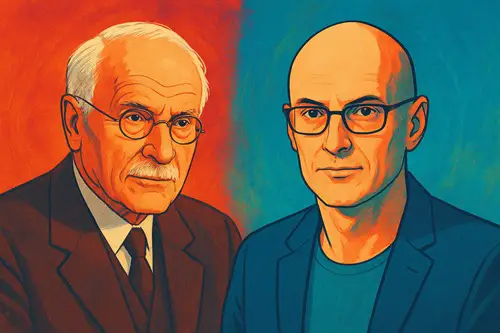 The intellectual encounter between C. G. Jung and Ken Wilber has always been strangely underdeveloped. Jung is one of the most influential depth psychologists of the twentieth century; Wilber positions himself as a grand synthesizer of psychology, spirituality, and developmental theory. One would expect a rich comparative literature. Instead, a tension persists: Jungians often accuse Wilber of reducing or misrepresenting their tradition, while Wilber insists he is merely clarifying confusions within Jung's own formulations. The truth is more intricate. Wilber understood Jung in parts—but also reconstructed him through his own developmental metaphysics, often distorting the original landscape. This essay examines the major fault lines: archetypes, the collective unconscious, the ego-Self dynamic, Wilber's developmental ontology, and the neglected divide between depth and height psychologies. 1. Jung's Pluralism vs. Wilber's SystemJung's thought is notoriously polyvalent. He shifts terminology across decades, speaks mythopoetically as often as theoretically, and usually avoids strict definitions. The archetype, for instance, oscillates between being:
Wilber, by contrast, prefers crisp distinctions, hierarchical sequencing, and universal developmental structures. He takes Jung's conceptual fluidity as ambiguity and seeks to systematize it. Thus he breaks Jung's psychology into components: some developmental, some pre-personal, some symbolic, and—critically—some “confused.” Here lies a basic tension: Did Wilber “clarify” Jung's ambiguities, or did he impose his own architecture onto a symbolic psychology that resists systematization? 2. Archetypes: Misreading or Disentangling?Jung's PositionJung understood archetypes as inherited potentials of the human psyche—pre-dispositional forms that shape symbolic experience. They are not inherited images but inherited possibilities of representation. Archetypes are timeless, immanent, and structural; they are not developmental stages. Wilber's ReadingWilber argues that Jung conflated two phenomena:
Because Wilber assumes that consciousness unfolds developmentally from pre-personal → personal → transpersonal, he reclassifies Jung's “archetypes” into two categories:
This has internal coherence—but it is Wilber's system, not Jung's. Jung rejected the notion of consciousness as a vertical hierarchy. Verdict: Wilber's differentiation is useful for his own model but distorts Jung's anti-hierarchical, symbolic ontology of psyche. 3. The Collective Unconscious: Flat or Vertical?Jung's ViewThe collective unconscious is a shared psychic substrate. It is not a ladder or sequence but a foundational, species-wide inheritance. Wilber's ObjectionWilber claims the collective unconscious conflates: archaic, instinctual material with transpersonal spiritual awareness. In his model, these belong to opposite ends of the developmental spectrum. Thus Jung allegedly commits a version of the “pre/trans fallacy.” AssessmentJung explicitly distinguished archetypes from instincts and treated mystical symbolism as an activation of psychic potentials—not higher metaphysical states. Wilber interprets these as ontologically higher realms, collapsing Jung's phenomenology into a metaphysical scheme Jung never endorsed. 4. The Self and Individuation: Symbolic vs. MetaphysicalJung's SelfThe Self is the symbolic totality of the psyche—a psychological concept describing wholeness, not a literal transcendent entity. The ego-Self dynamic is a process of integration, meaning, and symbolic depth. Wilber's ReinterpretationWilber relocates the Jungian Self into the transpersonal tier, reimagining it as a precursor to genuinely spiritual identity found in the perennial traditions. Thus, the Self becomes a higher developmental structure, not a symbolic totality. This move is coherent within Wilber's perennialist metaphysics but diverges sharply from Jung's psychological naturalism. 5. Epistemological Divide: Hermeneutics vs. Developmental OntologyThe deepest separation lies here:
Thus Wilber interprets Jung's “symbolic heights” and “symbolic depths” as literal ontological heights and depths. This alone produces large-scale misreadings. 6. Height Psychology vs. Depth Psychology: A Key to the DisagreementOne of the most illuminating lenses for understanding the Jung-Wilber conflict is the distinction between depth psychology and height psychology, a divide rarely made explicit. Depth Psychology (Jung, Grof, Washburn)Depth psychology aims downward: into origins, the unconscious, the instinctual, and the ancestral. Transformation involves:
For Jung, individuation often involves a katabasis, a descent into the psychic underworld. Washburn and Grof extend this: regression to the “Dynamic Ground” (Washburn) or the perinatal matrices (Grof) becomes spiritually transformative. Height Psychology (Assagioli, Wilber)Height psychology orients upward: moving toward clarity, higher states, illumination, and transcendence. Assagioli's Psychosynthesis introduces a Higher Self, a superconscious realm, and a model of ascent toward realization. Wilber continues this trajectory, portraying spiritual development as a vertical unfolding toward higher tiers. In height psychology:
Why This Matters for Jung vs. WilberJung's archetypes belong to the deep psyche, not to higher metaphysical planes. Wilber reclassifies some archetypal symbolism upward—asserting it reflects higher transpersonal structures—and classifies other parts downward as archaic. This split reflects the clash between height and depth orientations more than any internal inconsistency in Jung. Simply put:
They are playing different psychological games.
7. Did Wilber Understand Jung? A Balanced AccountingWhere Wilber understood Jung wellHe perceives Jung's fascination with myth, alchemy, and the symbolic. He recognizes Jung's exploration of deep layers beyond the personal ego. He sees Jung's openness to numinous, quasi-spiritual experiences. Where Wilber misunderstood or reinterpreted JungHe imposes a developmental hierarchy that Jung explicitly rejected. He treats archetypes as if they were developmental structures. He reads Jung's symbolic language as metaphysical description. He misinterprets Jung's anti-hierarchical collective unconscious as a conflation of lower and higher states. Where Wilber's distinctions are useful—but not JungianWilber's separation of archaic vs. genuinely transpersonal experiences clarifies certain clinical or meditative phenomena. But it is a reinterpretation, not a correction, of Jung. 8. Conclusion: A Productive MisunderstandingThe interface between Jung and Wilber remains understudied because they inhabit different psychological lineages and different epistemologies. Jung's symbolic, depth-oriented psychology explores the psyche as a nonlinear, mythic, meaning-generating field. Wilber's height-oriented developmentalism seeks structural coherence, ontological hierarchy, and vertical ascent. Wilber did not merely clarify Jung's ambiguities; he transposed Jung into his own perennialist architecture. This yields insights but also distortions. It is less an interpretation than a creative repurposing—a productive misunderstanding that reveals as much about Wilber's system as it does about Jung's psychology. A detailed comparative study remains overdue.
Comment Form is loading comments...
|